
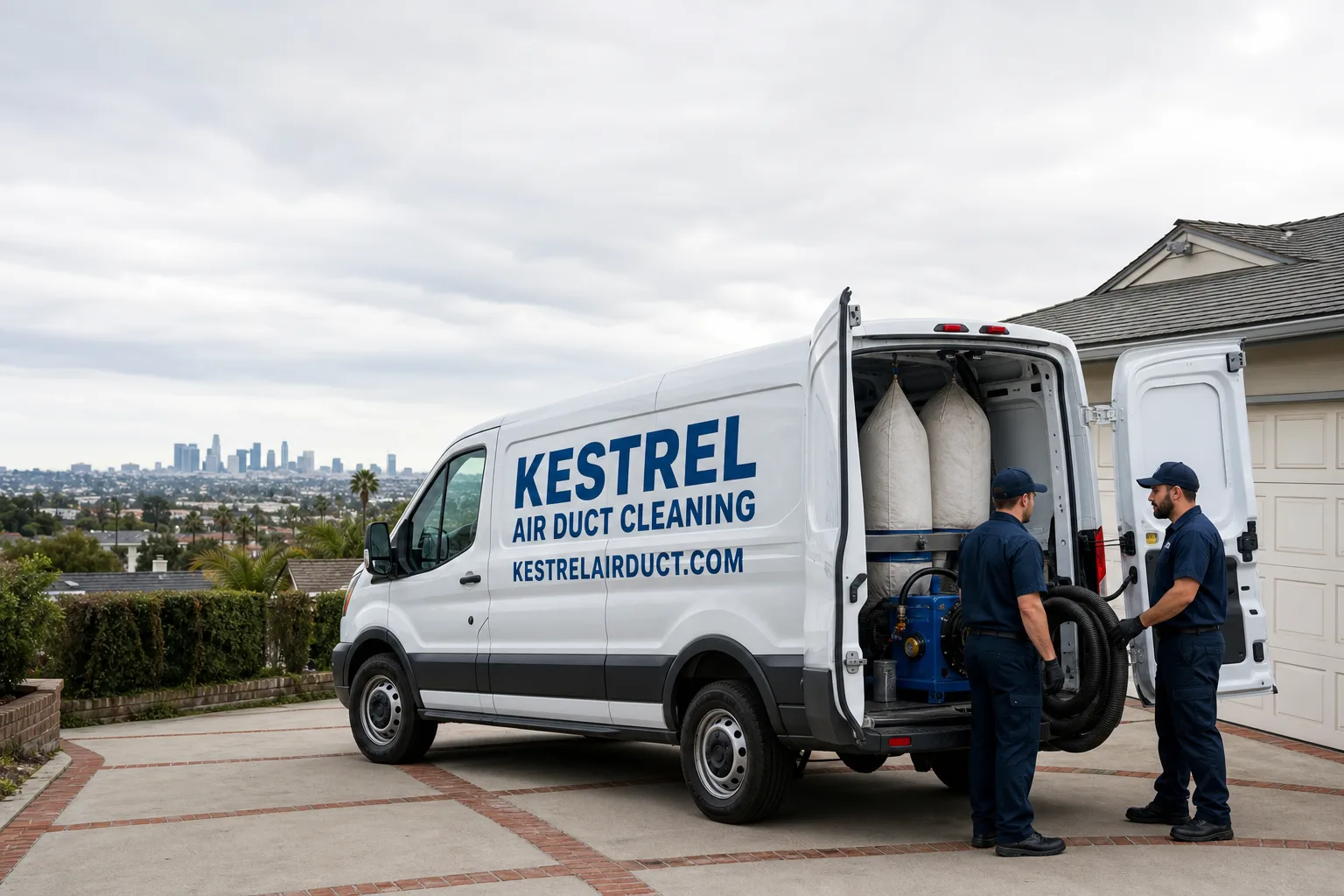
Whole-system duct and dryer vent check with before-and-after photos - you see exactly what came out of your vents
That "$99 whole-house special" is a bait ad - the real number appears once they are in your hallway, or the "clean" is a shop-vac at the register. We photograph the inside of your ducts before and after instead.




 Before
 After
After Before
 After
After Before
 After
AfterThe Dryer Shuts Off Before the Load Is Done
If your dryer is cutting out mid-cycle, a blocked dryer vent is the most likely cause. The machine overheats, the thermal safety switch trips, and the dryer shuts itself off to avoid a fire. Clearing the vent almost always fixes it.
Here’s the slightly longer version of that answer. Every dryer has a thermal cutoff – a safety switch that monitors the drum temperature. When hot, moist air can’t escape through the vent, it backs up inside the machine. The temperature climbs. The switch does exactly what it’s designed to do and kills the power. The problem isn’t the switch or the heating element in most cases. It’s that the hot air has nowhere to go. A lint-clogged or kinked dryer vent line is the most common reason dryers behave this way, and it’s the kind of thing that builds up slowly enough that most homeowners don’t notice it happening until the machine starts acting up.
Why It Happens
Lint Buildup in the Dryer Vent Line
This is the cause the vast majority of the time. Lint bypasses the interior filter on every load – not much, but enough to coat the inside of the vent line over months and years. Eventually the passage narrows to the point where the dryer can’t exhaust properly. You’ll often notice clothes still feeling damp when the machine shuts off, or the outside of the dryer cabinet feeling unusually hot to the touch during a cycle.
A Kinked or Crushed Transition Hose
The flexible section of duct that connects the dryer to the wall can get pushed in when the appliance is slid back into place after a move or a repair. Even a partial kink cuts the airflow enough to trigger overheating. Pull the dryer out a few inches and look at the flexible hose behind it. If it’s bent sharply or compressed flat anywhere, you’ve likely found your problem.
A Faulty Thermal Cutoff Fuse
The thermal cutoff fuse is a one-time safety device. Once it trips, the dryer won’t heat again even if the vent is cleared, because the fuse is blown. If your dryer runs but blows cold air, or starts and then immediately cuts off with no heat at all, the fuse may be gone. The important thing to understand here: if a fuse has blown, it blew for a reason. Replacing the fuse without clearing the vent just sets up the same failure again, usually faster.
A Blocked or Damaged Exterior Vent Cap
The cap at the outside of your home – wherever the vent exits through the wall, soffit, or roof – has a flap that opens when the dryer runs and closes when it doesn’t. Bird nests, debris, and damaged flaps that sit permanently closed all restrict airflow at the exit point. Walk around the outside of the house and find the vent termination. If the flap looks damaged, is stuck shut, or has visible debris packed around it, that’s worth noting before the technician arrives.
What to Do Right Now
- Stop using the dryer until it’s been inspected. A blocked vent is a fire hazard. The U.S. Fire Administration links thousands of dryer fires each year to dirty or blocked vents. Running the machine repeatedly while it’s overheating is not safe.
- Clean the lint screen if you haven’t already – though be aware this rarely fixes a mid-cycle shutoff on its own. The screen catches most lint, but the vent line beyond it is where the real accumulation happens.
- Pull the dryer forward and look at the flexible transition hose. Check for sharp kinks or sections that have been flattened. Take a photo. It helps the technician understand what they’re walking into before they get there.
- Find the exterior vent cap and take a look at it. If it’s on the roof or in a hard-to-reach location, don’t climb up – just note where it exits the house and let the technician handle it. Height and rooftop access are not a safe DIY task.
- Write down what you noticed and when. How many cycles has it been cutting off? Does the drum feel hot? Were clothes damp when it stopped? That kind of detail helps narrow the diagnosis quickly when your local Kestrel Air Duct Cleaning team arrives.
How We Fix It
When your local Kestrel Air Duct Cleaning team arrives, the first thing a technician does is assess the full vent line – from behind the dryer to the exterior cap – before touching anything. You’ll get a written price before any work starts. That’s not a policy we revisit at the door; it’s how every Kestrel job works, every time, under the Kingswell Guarantee.
For a standard dryer vent cleaning, the technician runs a Rotobrush rotary brush system through the vent line to break up compacted lint, then pulls it out with a Nikro negative-pressure unit. Abatement Technologies HEPA filtration keeps loosened debris from ending up in your laundry room. The exterior cap gets inspected and cleared. Most dryer vent cleanings take under two hours.
If the job also involves the home’s air duct system – which sometimes makes sense to address at the same visit – that’s a separate conversation with its own written estimate before anything begins.
The work is covered by our 365-Day Done Right Promise. If it’s not done right, we come back and make it right at no charge. That’s in writing on every job, not a verbal reassurance we extend at our discretion.
Frequently Asked Questions
It’s genuinely dangerous, not just inconvenient. A dryer that keeps overheating because it can’t exhaust properly is a fire risk – lint is highly combustible and vent fires can move into wall cavities quickly. Stop using the dryer until the vent has been inspected and cleared. Call (469) 972-3151 and your local Kestrel team will get it scheduled.
It should be dealt with promptly. Every cycle you run while the vent is blocked adds heat stress to the machine and increases the fire risk. A week of “it’ll probably be fine” is how a vent problem becomes a duct fire. Call (469) 972-3151 – a real person answers, any time of day.
In most cases, clearing the vent is the whole fix. If the thermal cutoff fuse has blown as a result of repeated overheating, that’s a dryer repair – not something Kestrel handles, since our services are dryer vent cleaning and air duct cleaning. We’ll tell you honestly on-site if what we’re looking at suggests an appliance repair rather than a vent cleaning, before any money changes hands.
That’s the right question to ask, and it’s exactly the kind of doubt that comes from dealing with companies that use coupons to get in the door and do minimal work. Kestrel technicians show you before-and-after photos of your own vent so you can see what came out. The job is backed by the 365-Day Done Right Promise – if the work falls short within that period, we come back and fix it at no charge, and that’s documented in writing before we leave.
Get It Fixed
A dryer that shuts off before the load is done is telling you something. Call (469) 972-3151 – a real person picks up, any time of day – and your local Kestrel Air Duct Cleaning team will schedule the visit, give you a written price before anything starts, and back the work for 365 days.
Written by Dale Whitmore, Owner at Kestrel Air Duct Cleaning. Each Kestrel location is independently owned and operated under the Kingswell Guarantee.
What Our Customers Say
"Our dryer was taking two cycles to dry a load. They cleaned the vent and pulled out a frightening amount of lint. Dries in one cycle now and honestly I feel better about the fire risk."
- Marcus Lee"Set up an appointment for the whole house plus the dryer line. They called the morning of to confirm, showed up in the window, and showed me pictures of the gunk they pulled out. Worth it."
- Terrence Boyd"My wife's allergies were awful every morning. Had the ducts done and it's made a real difference. Tech was on time and wore booties in the house without me asking."
- Rob Pendergast