
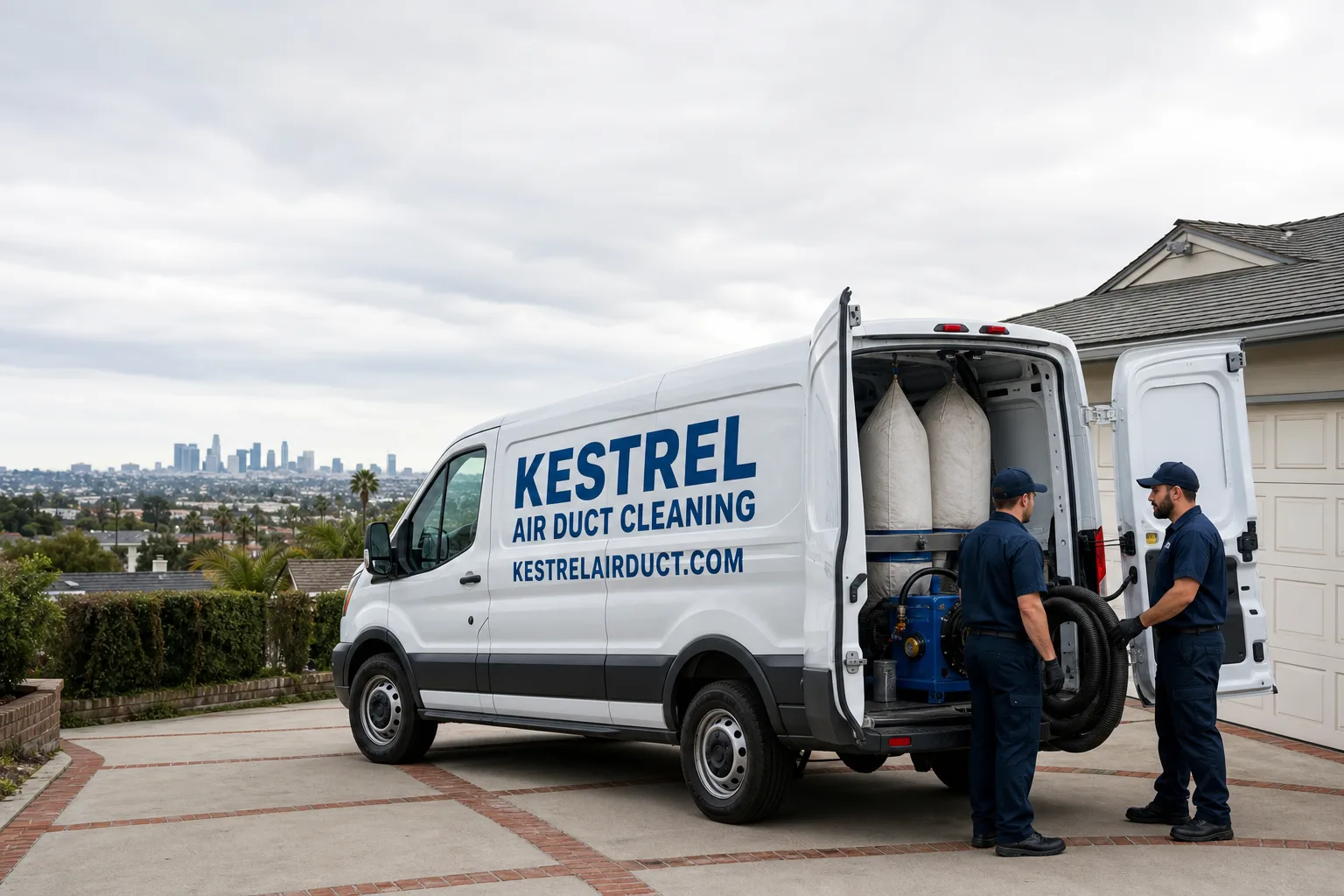
Whole-system duct and dryer vent check with before-and-after photos - you see exactly what came out of your vents
That "$99 whole-house special" is a bait ad - the real number appears once they are in your hallway, or the "clean" is a shop-vac at the register. We photograph the inside of your ducts before and after instead.




 Before
 After
After Before
 After
After Before
 After
AfterDusty Vents Right After Cleaning
If your vents looked dusty again within days of a cleaning, the cleaning almost certainly didn’t go deep enough – or it didn’t use the right equipment to dislodge and capture what’s actually built up inside the duct walls. A shop-vac-level job stirs surface debris without pulling the embedded layer out, so that layer shakes loose again the moment air starts moving. You’re not imagining it. The problem is real, and it’s fixable.
Here’s the fuller picture: duct systems collect dust in two very different places. There’s the loose stuff that sits near the register face and moves around easily. Then there’s the compacted layer pressed into the sheet metal or flex duct lining further back – the stuff that’s been accumulating since the last time anyone seriously cleaned the system. A cleaning that only addresses the first layer leaves the second layer intact. Within a few days of normal use, that deeper debris shakes free, travels toward the registers, and settles right back where you’re seeing it now.
Why It Happens
The equipment used wasn’t strong enough
A lot of cut-rate cleaners walk in with equipment you’d recognize from a home improvement store. That kind of suction handles loose surface dust but it can’t dislodge the compacted film bonded to duct walls from years of use. If you watched the technician work and didn’t see a rotary brush system being fed into the ducts, or didn’t hear the sustained pull of a high-capacity negative-pressure unit running through the job, the debris at the duct wall likely never moved. The dust you’re seeing now is that layer, redistributed.
The system wasn’t sealed during the cleaning
Professional duct cleaning works as a closed loop: technicians create negative pressure inside the duct system, then agitate debris toward a collection point. If the system isn’t properly sealed at the registers and access points during the process, loosened particles escape into the living space instead of being captured. You’d notice this as a general dustiness in the room – not just at the vents – in the hours after the job. That airborne material eventually settles back onto the register faces and nearby surfaces.
The filter was reinstalled without being replaced or checked
A clogged or low-quality filter at the air handler restricts the system’s ability to capture fine particles after a cleaning. If the technician cleaned the ducts but didn’t flag a degraded filter, the system is pulling air through something that can’t do its job. Dusty registers within a day or two of cleaning – especially if the dust appears uniformly fine and powdery rather than fibrous and clumped – is a common sign the filtration side of the system was overlooked. Check your filter: if it’s visibly grey and loaded, that’s your answer.
The original job skipped the branch lines
Main trunk lines are easy to access. Branch lines – the smaller ducts that run to individual rooms – take more time and the right attachments to clean properly. A technician working fast may clean the accessible main lines and call it done. If one or two rooms in particular seem worse than others, or if the dustiest registers are at the ends of long duct runs rather than near the air handler, the branch lines for those runs likely weren’t touched. You can often confirm this by shining a flashlight into a register that’s dusty and comparing it to one that isn’t.
What to Do Right Now
- Photograph the dusty registers before you touch them. Get a clear shot of the register face and, if you can, what you can see just inside the duct opening. That documentation matters if you need to go back to whoever did the original job, and it helps a technician assess severity before arrival.
- Check and swap the air filter. Pull the filter at your air handler or return-air grille. If it’s visibly loaded – grey, stiff, or shedding – replace it with a clean one before running the system further. Running a dirty filter after a duct cleaning puts the debris problem right back into circulation.
- Run the fan on “on” rather than “auto” for 30 minutes, then re-examine. This isn’t a fix, but it tells you whether the dust is airborne and redistributing (it’ll look worse) or sitting static on the register face (it won’t change much). That distinction helps diagnose the severity.
- Don’t run the HVAC system any more than necessary until the problem is assessed. Every cycle pushes more air through ducts that may still be loaded, redepositing debris at registers and into the living space. Limit runtime if you can while you arrange a proper evaluation.
- Do not try to access the ductwork at the air handler yourself. The air handler connects to the electrical system and, in many homes, to gas lines. Neither of those is a DIY situation. Stay at the register level – that’s safe to look at and photograph – and leave anything past the handler cabinet to a trained technician.
How We Fix It
When your local Kestrel Air Duct Cleaning team arrives, the first thing they do is walk the system with you – registers, return-air grilles, the air handler access – and look at what’s actually in front of them before making any claims about what’s needed. That’s how we give you a written price before a single duct gets opened. No estimates revised after the van’s in the driveway.
The cleaning itself uses a Rotobrush rotary brush system to break the compacted debris layer off the duct walls, a Nikro negative-pressure unit pulling continuously so that debris travels toward collection rather than into the room, and Abatement Technologies HEPA filtration to capture the fine particles that get stirred up in the process. Branch lines get the same attention as mains – every run in the scope of work.
A standard residential air duct cleaning job typically runs a few hours. If the filter situation needs addressing, we’ll discuss Honeywell or Aprilaire filtration options while we’re there – no pressure, just the information. And everything we do is covered by the 365-Day Done Right Promise: if the work falls short within the guarantee period, we come back and make it right, at no charge, documented in writing.
Frequently Asked Questions
It’s a sign something was missed or underperformed – it’s not a normal part of the process. A properly done cleaning with the right agitation and negative-pressure equipment shouldn’t produce a fresh dust problem within days. Some very light settling near registers in the first 24 hours after cleaning is possible, but recurring or heavy dust accumulation is a red flag that the duct walls weren’t properly cleaned, the system wasn’t sealed during the job, or the filter situation wasn’t addressed.
It depends on what’s in the dust. General household dust at the registers is a nuisance problem – uncomfortable but not immediately dangerous for most people. If anyone in your home has asthma, allergies, or a respiratory condition, or if the dust has a musty smell or any visible discoloration, don’t put it off. Redistributed debris can include mold spores, fine particulates, and allergens that circulate every time the system runs. If you’re in doubt, call (469) 972-3151 and describe what you’re seeing – a live person will pick up and help you figure out next steps.
Often, yes. The “per-vent” pricing model that shows up in low-cost coupons is a structural incentive to rush the job – more vents cleaned faster means more jobs in a day. Professional cleaning isn’t about counting vents; it’s about the time and equipment needed to clean the duct wall through the whole system. At Kestrel, we price by the system, in writing, before we start – so you know exactly what you’re getting and what it costs before anyone picks up a brush. Call (469) 972-3151 for a free written estimate.
Your local Kestrel Air Duct Cleaning team schedules jobs as quickly as availability allows – call (469) 972-3151 and a live person will tell you exactly what the next available window looks like. We give you a real arrival window and we show up in it. That’s part of The Kingswell Way, not a policy we follow when convenient.
Get It Fixed
Dusty vents after a cleaning mean the job needs to be done right. Your local Kestrel Air Duct Cleaning team will give you a written price before anything starts, use professional-grade equipment on the full system, and back the work with the 365-Day Done Right Promise. Call (469) 972-3151 – a real person answers, any time.
Written by Dale Whitmore, Owner at Kestrel Air Duct Cleaning, serving communities nationwide under the Kingswell Guarantee since 2004.
What Our Customers Say
"Set up an appointment for the whole house plus the dryer line. They called the morning of to confirm, showed up in the window, and showed me pictures of the gunk they pulled out. Worth it."
- Terrence Boyd"My wife's allergies were awful every morning. Had the ducts done and it's made a real difference. Tech was on time and wore booties in the house without me asking."
- Rob Pendergast"Bought an older home and the previous owners had pets everywhere. After Kestrel did the ducts the stale smell was just gone. On time, quick, and they showed me the filter they pulled."
- Preston Ngata