
Top Signs You Need Air Duct Cleaning Service – Don’t Ignore These
Dust on a register grille is almost always a filter problem, not a duct problem. The signs that your ducts genuinely need cleaning are quieter and less photogenic: they live in your utility bill, your allergy calendar, and the smell on the first heat cycle of the season. This post walks through the signals that actually mean something, and the ones you can safely ignore. If you’d rather skip the detective work and have a pro take a look, call Kestrel Air Duct Cleaning at (469) 972-3151.
The truth is, most homeowners in Los Angeles get this backwards. We’ve been in hundreds of homes where someone asked us to clean their ducts because of one dusty vent grille, when the real signal was a training-clogged filter three feet away. Meanwhile, the ducts that actually needed work were in the guest room nobody uses, where a remodel had blown drywall dust past the filter two summers ago. The signs below are organized by where they come from, because a signal’s source tells you more than its volume.
The False Signals: What Viral Posts Get Wrong
Before we get to the real signs, let’s clear out the noise. Three things send homeowners to the phone for duct cleaning when the ducts are probably fine.
- Dust on the register grille. Register grilles collect dust because air passes through them. That dust is often insulation fibers or ordinary household dust that settled there from the room itself. It is not proof that the ducts behind the grille are lined with debris. If you wipe the grille and the dust returns in three days, check your filter first.
- Occasional sneezing. Sneezing is seasonal pollen, a neighbor’s cat, or a dusty ceiling fan. It is not a duct-cleaning diagnosis. Allergies that get worse specifically when the HVAC runs, in every room, are a different story.
- The “ducts haven’t been cleaned in years” claim. Years alone mean nothing. A well-filtered system in a low-dust home can go a long time without needing cleaning. A system that ran unfiltered through a remodel can need cleaning after six weeks. Frequency is about load, not time.
Chasing these false signals leads homeowners in Los Angeles to clean ducts that are fine while ignoring the ones that aren’t. The real signs are below, and they’re measured, not guessed.
Real Sign #1: Per-Room Airflow Imbalance
Walk through your home on an ordinary day and put your hand in front of each register. Not one room, all of them. If one bedroom gets a weak, lukewarm trickle while the hallway register blows like a fan, you have a flow imbalance. That imbalance is a duct problem, not a thermostat problem, and it’s the single most underrated sign that something is restricting air inside the ductwork.
What causes per-room imbalance? Debris builds up unevenly. A return duct that pulls air from a hallway will collect more lint and dust than a supply branch in a spare bedroom. Over time, that buildup narrows the effective diameter of the duct. The HVAC system pushes air through the path of least resistance, so the open rooms get stronger airflow and the restricted rooms get starved. Your system is working harder to move less air, which brings us to the second real sign.
Real Sign #2: Longer Cooling Cycles Without a Temperature Change
Here’s a test you can run on any Los Angeles summer afternoon. On a day when the temperature holds steady, note how long your air conditioner runs to drop the thermostat by one degree. Do the same test a month later under similar conditions. If the cycle time has stretched noticeably longer, and your energy bill has crept up with it, restricted airflow is the most likely cause.
Duct debris acts like a blanket on the coils and a plug in the lines. The system has to push conditioned air through a narrower path, which means it runs longer to hit the same set point. That’s not a comfort quirk, it’s a utility-bill signal. When we clean ducts with serious buildup, we measure the airflow before and after. The difference is often a 15-20% improvement in delivered air, which translates directly into shorter run times and lower bills. If your system sounds like it’s running a marathon every afternoon and your bill reflects it, the ducts are worth a look.
Real Sign #3: The First-Heat Burning Smell That Lingers Past 10 Minutes
Every HVAC system has a first-heat smell when the season turns. Dust settles on the heat exchanger during months of disuse, and when the furnace fires for the first time, that dust burns off with a faint, brief odor. That smell should fade within 5-10 minutes of the first cycle. If it doesn’t, if it returns every time the heat kicks on for the first week of winter, or if it smells acrid rather than dusty, something more than surface dust is involved.
In Los Angeles, many homes run the furnace so rarely that debris accumulates in the ductwork for months at a time. When the heat finally comes on, that debris bakes in place. The smell is the HVAC system telling you there’s more dust in the ducts than a simple burn-off can handle. Persistent burning smell on heat cycles is one of the few signs we tell homeowners not to ignore, because it means particulate is being pushed into the living space every time the system runs.
Real Sign #4: Post-Renovation Debris, Especially Drywall Dust
Los Angeles homes get remodeled constantly. Kitchen gut jobs, bathroom updates, garage conversions, ADU builds. Every one of those projects sends drywall dust, wood fiber, and insulation particles into the air. If the HVAC system ran during the remodel, or even if it didn’t but the dust settled into the registers, that fine particulate is now inside the ducts.
Drywall dust is different from ordinary household dust. It’s finer, stickier, and it coats duct lining surfaces in a way that normal seasonal debris does not. A standard filter catches some of it, but fine drywall particulate passes through most 1-inch filters without slowing down. Once it’s inside the duct, it sits on the walls, waiting for the next system startup to push it back into the home.
If you’ve had drywall work done in the last year and you’re seeing chalky dust on surfaces near the registers, or if the air feels heavy when the system runs, that’s a renovation trigger. The fix is a through cleaning, not a filter change. Our technicians use Rotobrush rotary brush systems to dislodge debris from the duct wall, then Nikro negative-pressure units to pull it out before it can re-enter the home. The brush agitates, the negative-pressure extraction removes. Two steps, in that order, every time.
Real Sign #5: Rodent Signals from Specific Registers
Rodents in ducts leave a signature that’s completely different from ordinary dust buildup. Here’s what to listen and look for:
- Localized scratching sounds. If you hear scratching from one register in one room, not distributed across the whole system, that’s a rodent, not an air noise. Duct systems are metal. Sound travels. When you hear scratching from a single location, it’s coming from that location.
- An ammonia-like smell from one zone only. Rodent urine has a sharp, ammonia-like odor that’s unmistakable once you’ve smelled it. If that smell comes from one register or one room, and nowhere else in the house, that’s a rodent latrine inside that duct run.
- Debris at a single register. If you see insulation fragments, fiber scraps, or odd debris at one register and not at others, a rodent has been nesting in that specific duct branch. Distributed dust across all registers is normal. Concentrated debris at one register is a nest.
This is the one case where we tell homeowners to stop investigating and call a professional. Rodent contamination inside ducts is not a weekend DIY job. The duct run needs to be cleaned, sanitized, and inspected for gaps that let the rodent in. If the entry point isn’t sealed, the problem returns within weeks. We’ve seen this in homes all over Los Angeles, from Encino to Silver Lake, and the pattern is always the same: a single register, a single smell, and a well-worn rodent path behind the drywall.
Real Sign #6: Ash Residue After Wildfire Season
Los Angeles wildfire seasons are getting longer and the smoke is getting closer. Even homes miles from a burn zone get smoke infiltration, and here’s what most people don’t know: ash particulate doesn’t behave like dust. It’s heavier, it’s oily, and it embeds in fibrous duct liner in a way that standard household dust never will.
The telltale problem with ash is that it doesn’t show up on a standard register-wipe test. Wipe a white tissue across your register grille after a smoke event and you might see nothing. The ash has already settled deeper in the system, bonded to the duct liner or sitting in the return plenum. It only re-enters the living space when the system runs and the moving air loosens it enough to carry it forward.
If you live in a Los Angeles neighborhood that got smoke exposure, and you’ve noticed a campfire smell when the AC first kicks on, or a greasy film on surfaces near the registers, that’s ash residue in the ducts. A standard cleaning with negative-air extraction handles it, but the extraction needs to be genuinely powerful. This is where Abatement Technologies HEPA filtration matters: the HEPA filter traps loosened particles so they don’t get pushed back into the living space during the cleaning itself. Without HEPA filtration, a duct cleaning can stir up more than it removes. With it, the job is genuinely cleaner when the technicians leave.
The 15-Minute Self-Check Protocol
Before you call anyone, run these three checks. They take about 15 minutes total and will tell you whether you’re looking at a real duct problem or a filter-change fix.
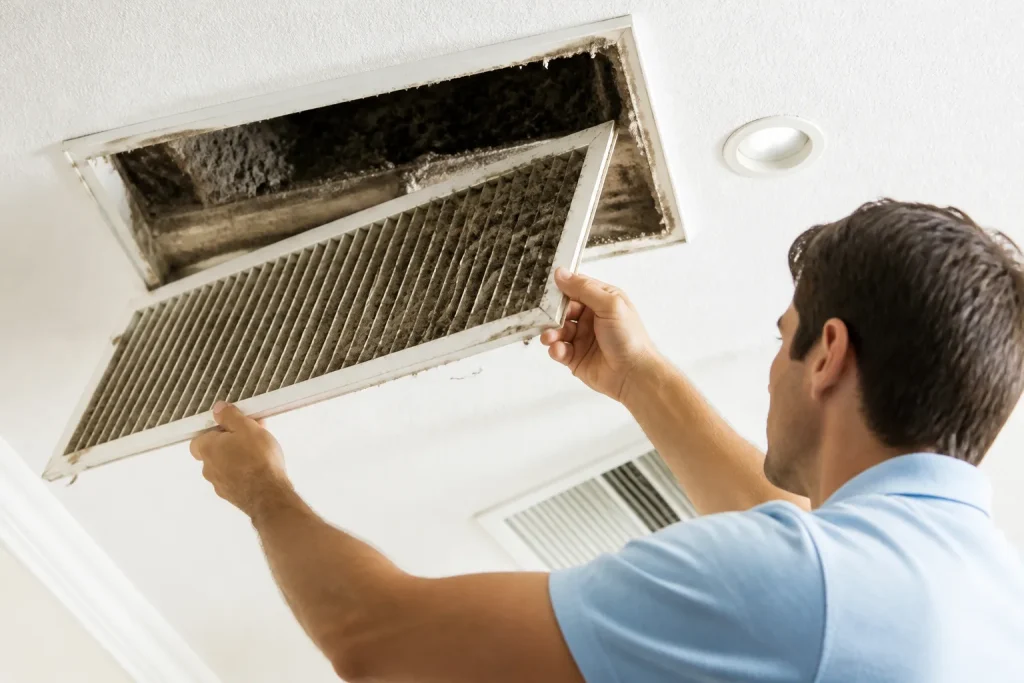
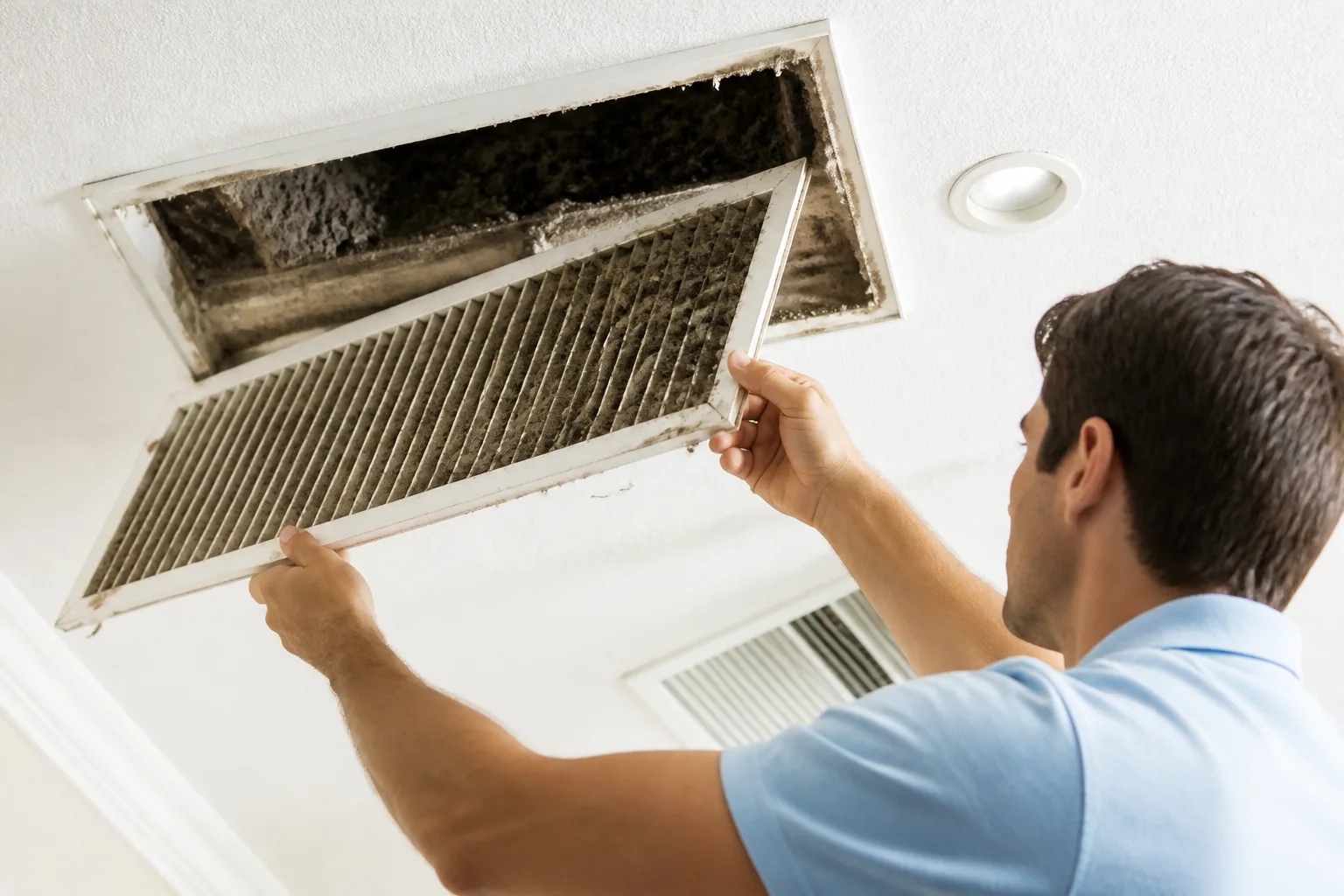
- Flashlight at the register. Remove a register grille in the room you suspect most. Shine a flashlight into the duct opening and look at the walls. If you see a visible, textured coating of dust or debris on the duct wall itself, not just a few dust bunnies, that’s meaningful buildup. If the duct walls look relatively clean, the problem may be elsewhere.
- Airflow comparison by floor. Walk from room to room with your hand at each register while the system runs. Note which rooms feel weak and which feel strong. If the imbalance is consistent across multiple visits, and the filter is clean, restriction inside the ducts is the likely cause.
- Filter check date review. Write down the last time you changed your filter. If it’s been more than 90 days, change it now and re-run the airflow comparison in a week. A clogged filter can cause every symptom on this list. Rule it out first.
If the filter is fresh, the airflow is still imbalanced, and the flashlight shows duct-wall buildup, you have a real duct-cleaning candidate. That’s when it’s time to call.
When to Call a Pro
Some signs are worth a phone call without the self-check. Persistent burning smell on heat cycles. Rodent signals from a single register. Renovation dust after a drywall project. Wildfire smoke residue. These are situations where waiting costs more than the call does, and where a professional cleaning with proper extraction prevents the problem from spreading.
Related services in Los Angeles: if you’re dealing with a dryer that’s taking longer to dry clothes, that’s a separate issue from the ducts. See our Dryer Vent Cleaning in Los Angeles page for the specific signs. And for a full overview of what duct cleaning involves, start with our Air Duct Cleaning in Los Angeles page.
Here’s the thing we want every Los Angeles homeowner to understand before they spend a dollar: the price should be in writing before work starts. Every job we do operates under the Kingswell Guarantee, which means a written price before any vent is touched, a defined arrival window, a clean job site when we leave, and a 365-Day Done Right Promise in writing. If the work falls short within the guarantee period, we return and make it right at no charge. That’s not a promotional offer. It’s been the standard since 2004.
We’ve pulled some memorable things out of ducts over the years. Last spring we cleaned a system in a Los Feliz home where the previous owners had run the HVAC during a kitchen remodel, and the return trunk was lined with a quarter-inch of drywall dust. The homeowner had been running an air purifier in the bedroom for a year, wondering why the air still felt heavy. The purifier was fine. The ducts were the problem.
If you’ve read this far and something on this list sounds familiar, you’re probably not wrong. Call us at (469) 972-3151 for a free estimate. A real person answers, any time of day, and we’ll walk through what you’re seeing before we ever schedule a visit.
For more on how we work and what we stand behind, start at the Kestrel Air Duct Cleaning home page.
The Bottom Line
Most duct-cleaning sales pitches start with dust on a grille. Real duct problems announce themselves through airflow imbalance, longer cooling cycles, lingering heat-cycle smells, renovation dust, rodent signatures, and post-wildfire ash. Learn to read those signals and you’ll spend money on cleaning when it actually matters, not when a social media post scares you into it.
If you’re in Los Angeles and need help figuring out which signal you’re seeing, Kestrel Air Duct Cleaning offers free estimates. Call (469) 972-3151 and talk to a real person. No pressure, no door-step surprises, just a straight answer about what’s going on in your ducts.
Frequently Asked Questions
You need cleaning if you see duct-wall buildup with a flashlight, notice consistent airflow differences between rooms, smell burning dust on heat cycles that lasts past 10 minutes, or have had drywall work, rodent activity, or wildfire smoke exposure in the home. Dust on the register grille alone is not a reliable sign. Call (469) 972-3151 for a free estimate if you’re seeing any of the real signals above.
Dusty vents can aggravate allergies or respiratory conditions if the system is pushing particulate into the living space, but the particles themselves are rarely the sole cause of illness. The bigger issue is persistent exposure to fine particulate like drywall dust or ash residue, which can irritate airways over time. If symptoms worsen when the HVAC runs and improve when it’s off, the ducts are worth inspecting.
Most Los Angeles homes run between $450 and $850 for a full-system cleaning, depending on home size, number of return vents, and the condition of the ductwork. Kestrel gives you a written price before any work starts, so the number you’re handed is the number you pay. Call (469) 972-3151 for a specific quote on your home.
Cheaper quotes often come from companies that skip the negative-air extraction step or use underpowered equipment that dislodges debris without removing it from the system. Some low-price operators also upsell aggressively once they’re in the home, turning a $99 coupon into a $900 invoice. We run Rotobrush rotary brushes with Nikro negative-pressure extraction and Abatement Technologies HEPA filtration, and we put the price in writing before the job starts. No door-step revisions, ever.
Written by Dale Whitmore, Owner at Kestrel Air Duct Cleaning, serving Los Angeles since 2004.
Need Air Duct Cleaning Help?
Call Kestrel Air Duct Cleaning - licensed & insured, here with fast after-hours help in Los Angeles.
(469) 972-3151