
Preparing Your Home’s Air Duct Cleaning for Winter in Los Angeles
You’re not imagining it. The air coming out of your vents on the first cool night of November smells like a campfire that burned out six years ago. Here’s what’s actually happening: your Los Angeles home’s ducts have been sitting static since April, collecting six months of fine dust, dried pollen, and whatever the Santa Ana winds pushed through your return-air grilles. When the heat kicks on, all of it gets blasted through every room at once. The fix is a single fall cleaning before you ever touch the thermostat. If you’d rather not wrestle with ladders and flashlights, call (469) 972-3151 and we’ll handle it from the driveway to the last vent.
Why October and November Are the Highest-Value Months for Duct Cleaning in Los Angeles
In most of the country, fall duct cleaning is about clearing out what accumulated during a humid summer. Los Angeles is different. Our dry season runs from roughly April through October, and during those months, a forced-air system pulls in whatever is floating through the air outside. That means fine silica dust from dry earth, dried pollen from the late-summer bloom cycle, and yes, ash particulate from any regional wildfire smoke that drifted through the basin. The heat has not run since spring, so none of this has been disturbed. It has just been sitting, compacting along the walls of your return ducts and onto the face of your filter housing.
By late October, two things are about to happen: the first cold snap is days or weeks away, and the holiday hosting season is starting. If you clean before either one, you are not just tidying up. You are preventing the single largest dust release of the year from happening on the same night you have out-of-town guests sleeping in the spare room. We have had customers in neighborhoods from Sherman Oaks to Pasadena tell us the exact same thing: the first time the heat came on, the whole house smelled like a vacuum bag. Cleaning in October removes that variable entirely.
What Actually Accumulates in LA Duct Systems Over a Dry Summer
Duct debris is not one thing. It is a mix, and the mix in Los Angeles is specific to our climate and geography. Three types dominate what we see when we open a return-air grille in a home that has not been cleaned in a year or more.
- Fine silica dust. Los Angeles sits on a dry, dusty landscape. Wind and foot traffic throw a constant stream of very fine mineral particles into the air. They enter through open windows, door gaps, and the negative pressure created when a bathroom fan runs. This dust is small enough to pass through many standard filters and settle along the interior walls of duct runs.
- Dried pollen from the fall bloom cycle. Most people associate pollen with spring, but in Southern California, several plant species release pollen again between September and November. By the time heating season starts, this second wave has had weeks to drift through intake grilles and bond to the dust already in place.
- Ash particulate from regional wildfire smoke. Even if a fire is 60 miles away, the smoke it produces carries fine ash and carbon particles that ride the wind into the LA basin. These particles are small, sticky when combined with humidity, and they coat the inside of return ducts and blower cabinets in a fine gray film. We see this consistently in homes across Los Angeles after fire season, regardless of how well the windows were kept shut.
None of this is a reflection on your housekeeping. It is a consequence of living in a dry, windy climate and running a forced-air system that breathes the same air you do.
How to Check Your Own Return-Air Grilles Before Calling Anyone
Before you schedule a cleaning, you can run a two-minute test that tells you whether the system needs attention or just a new filter. You need a flashlight and a clean white cloth or paper towel. Walk to your largest return-air grille, the one usually located in a hallway or near the thermostat. Shine the flashlight through the slats at an angle, and look for a gray or brown coating on the backside of the grille itself and on the inside of the duct boot behind it.
Then do the drag test. Take the white cloth and press it firmly against the inside face of the grille. Drag it about six inches. If the cloth comes away with a visible gray line, that is not filter dust. That is accumulated debris that has made it past the filter and is now living inside your return system. If the cloth stays clean and the behind-the-grille area looks clear, you likely need a filter swap and not much more. One more check: remove the filter itself and look at the blower wheel or the filter slot edge with the flashlight. A dust ridge along the slot edge means debris is being pulled past the filter seal, which is a common problem in older Los Angeles homes where filter cabinets have warped slightly over time.
This test takes five minutes and costs nothing. It also gives you a much better conversation with any contractor you call, because you will already know whether the system is visibly dirty or marginal. When we do a first visit, this is the same visual assessment we start with, though we use extraction equipment to confirm what is actually moving through the system rather than what is simply stuck to the grille.
What “Winterizing” Means for an LA Forced-Air System (It’s Not What You’d Think)
In cold climates, winterizing an HVAC system means insulating pipes, testing a humidifier, and making sure the condensate line will not freeze. In Los Angeles, those steps are largely irrelevant. What matters here is what happens when a furnace that has been idle for six months is asked to produce heat again. The most important component to understand is the heat exchanger.
A gas furnace heat exchanger is a metal chamber that separates the burning gas from the air that blows into your home. When a furnace sits unused for half the year, a few things happen. Dust settles inside the burner compartment. Small spiders and insects sometimes build in the burner tubes. And any microscopic crack that formed during the previous heating season has had months to sit undisturbed. When heat kicks on for the first time, the system burns off that accumulated dust, which is the smell homeowners often describe as “that heater smell.” In most cases, it is harmless and clears in an hour. But a cracked heat exchanger is a carbon monoxide risk, and it does not announce itself with a smell.
This is not a DIY inspection item. If your furnace is more than ten years old and you have not had a combustion safety check, a technician should look at the heat exchanger before the first heavy heat use of the season. Duct cleaning is the right moment to flag this, because a thorough cleaning includes access to the blower compartment and return plenum, where early signs of rust or soot sometimes show up. The point of fall prep in Los Angeles is not to insulate pipes. It is to make sure the system can run safely after a long idle period, and to make sure it is not blowing six months of accumulated debris through the house when it does.
How to Book Fall Duct Cleaning in Los Angeles Without Getting Stuck on a Six-Week Wait
The demand pattern for duct cleaning in Los Angeles is predictable. Calls spike in the last two weeks of October and the first two weeks of November, right when the first cold night hits and the “heater smell” conversation starts happening in every house on the block. If you wait until Thanksgiving week, you are competing with every homeowner who just realized their furnace is blowing dust the same week they are hosting 12 people. Wait times stretch, and you may be choosing between a rushed job and a January appointment.
The practical window to book is mid-September through mid-October. That puts you behind the worst of the summer heat, after the peak of Santa Ana wind season, and comfortably ahead of the holiday crunch. It also means your system is clean before the first cold snap, not after you have already blown a winter’s worth of dust through the living room. When you call, a few things make the conversation faster. Know the square footage of your home or at least the number of rooms and returns. Know whether your system has flexible ducting or rigid metal, if you can tell. And ask for a written price over the phone before anyone is scheduled. Any reputable contractor in Los Angeles should be able to give you a firm range based on home size and system type without needing to “see it first.” Written pricing is standard for us at Air Duct Cleaning in Los Angeles, and it should be standard for anyone you hire.
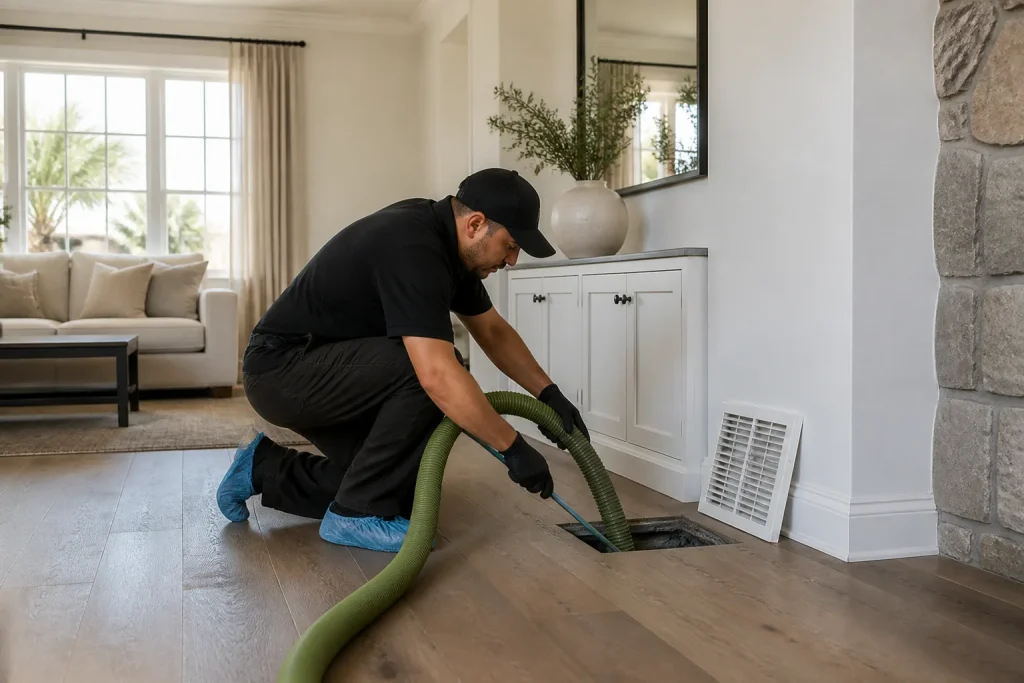
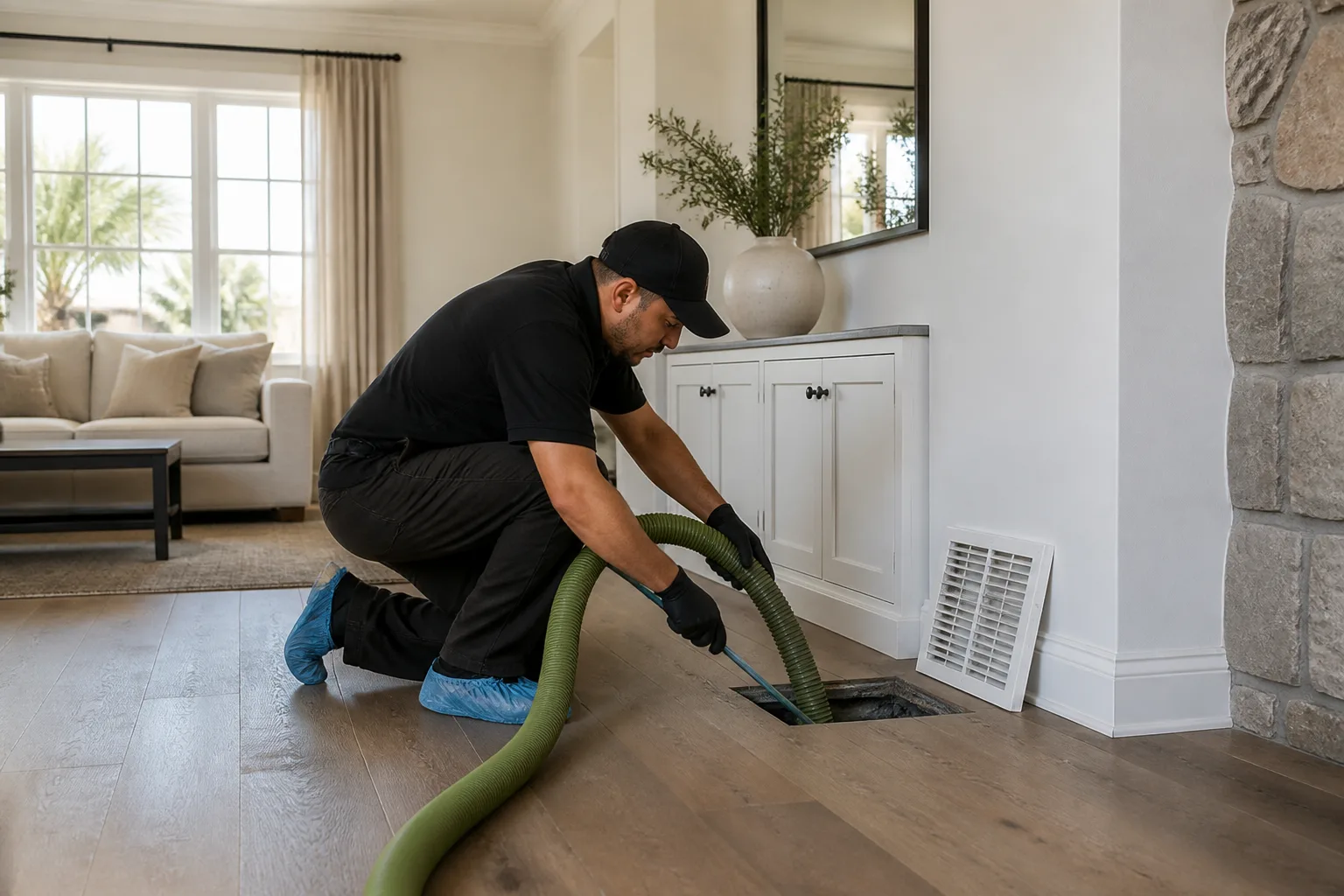
When you are ready, we keep it simple. Call, get a written price, pick a window, and the crew shows up in uniform. We run Rotobrush rotary agitation tools through the duct runs to break debris loose from the walls, pair them with Nikro negative-air units that pull the loosened material outward, and keep Honeywell filtration recommendations on hand for homes that want cleaner air between visits. It is not a rushed job and it is not priced by the vent. One written number for the whole system, before we touch anything.
When to Call a Pro
If your white-cloth drag test comes back gray, or your furnace is due for a heat exchanger check, or you simply do not want to spend a Saturday on a ladder with a flashlight, this is the point where a professional makes sense. A proper cleaning is not a filter change. It requires negative-pressure extraction so dust does not get pushed into the living space, agitation tools sized to the duct runs, and enough time to do every run, not just the ones near the thermostat. If you are in Los Angeles and want the system cleaned before the first cold night, we can help. See Dryer Vent Cleaning in Los Angeles for the other service we offer to get the house ready for winter.
The Bottom Line
In Los Angeles, the smartest winter prep is not insulation or freeze protection. It is cleaning the ducts before the first heat use of the season, so six months of accumulated dust, pollen, and ash is gone before it gets pushed through every room. October is the window. A five-minute grille test tells you whether a full cleaning is warranted or a filter swap will do. And if the system needs work, get a written price before scheduling so there are no revisions at the door. If you’re in Los Angeles and need help, Kestrel Air Duct Cleaning offers free estimates and a written price before any work starts. Call (469) 972-3151 and we’ll get you on the schedule before the holiday squeeze.
Frequently Asked Questions
In a dry, windy climate like Los Angeles, most homes benefit from a professional cleaning every 3 to 5 years, but that range tightens if you live near a busy road, leave windows open often during Santa Ana season, or have pets. The best gauge is the white-cloth drag test on your return grille. If the cloth comes back gray after a six-inch drag, the system has enough accumulated debris to justify a cleaning. Homes that run the AC constantly through summer and then switch to heat in November sometimes need attention sooner. Call (469) 972-3151 and describe what you’re seeing; we’ll give you a written price before scheduling anything.
Most single-family homes in Los Angeles run between $450 and $900 for a full-system cleaning, depending on the number of returns, the length of duct runs, and whether the system uses flexible or rigid metal ducting. That is the honest range for a real job with negative-pressure extraction and agitation tools, not a bait price that climbs once a tech is in the driveway. We provide a written price based on the specific system before any work starts. Call (469) 972-3151 and we’ll walk through your home size and system type in about five minutes.
Because they are quoting a different job. A $99 whole-house special is typically built on a marketing model where the technician arrives and then re-prices the job based on what the system “actually needs,” which is how a low teaser becomes a four-figure invoice. The work itself also varies: a box-store shop vac attached to one vent is not the same as negative-pressure extraction with an agitation tool in every run. We hold to one written price per system, agreed before we touch a vent. If the quote seems too low to be real, it is. Call (469) 972-3151 and we will explain exactly what our price includes.
Ask for before-and-after photos of your own duct interior, taken during the job. A legitimate contractor will show you the return plenum, a mid-run section, and a supply register before and after cleaning. If a company cannot produce those, you are trusting a verbal promise. We document every job with before-and-after photos and leave the system cleaner than we found it. Our Done Right Promise covers the work in writing: if something falls short within the guarantee period, we return and make it right at no charge. Call (469) 972-3151 for a free estimate.
Written by the team at Kestrel Air Duct Cleaning.
Need Air Duct Cleaning Help?
Call Kestrel Air Duct Cleaning - licensed & insured, here with fast after-hours help in Los Angeles.
(469) 972-3151