
Air Duct Cleaning: Repair or Replace? How Los Angeles Homeowners Decide
Most Los Angeles homeowners shouldn’t be deciding between repair and replacement at all. The first question is whether your ducts are even leaking, and the only way to know that is a $150 pressure test, not a visual inspection. Here’s the honest sequence: clean first if you haven’t in years, test if you suspect leakage, repair if leakage is between 6% and 25%, and replace only when it crosses 30%. If you’d rather skip the guesswork, call Kestrel Air Duct Cleaning home at (469) 972-3151 and we’ll walk through it with you.
A duct system in a 1965 Burbank ranch house might test tighter than a 2015 Westside new-build. Age tells you almost nothing about leakage rate, and leakage rate is the only number that determines whether replacement makes financial sense.
Why Cleaning Comes Before Any Repair or Replace Decision
You can’t diagnose what you can’t see. A duct system caked with twenty years of dust, pet hair, and construction debris hides every problem underneath. Joints that might be sealed perfectly look compromised through a quarter-inch of grime. Flex duct that’s actually intact looks sagging and failed. Before you spend a dollar on repairs or drop thousands on replacement, get the system cleaned so you’re evaluating what’s actually there.
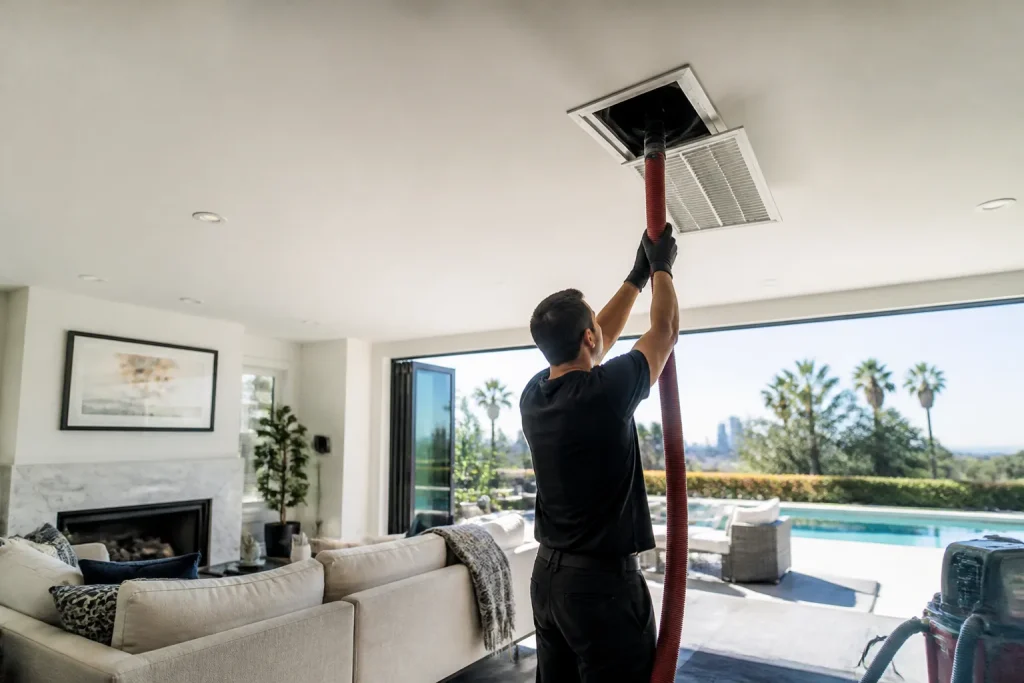
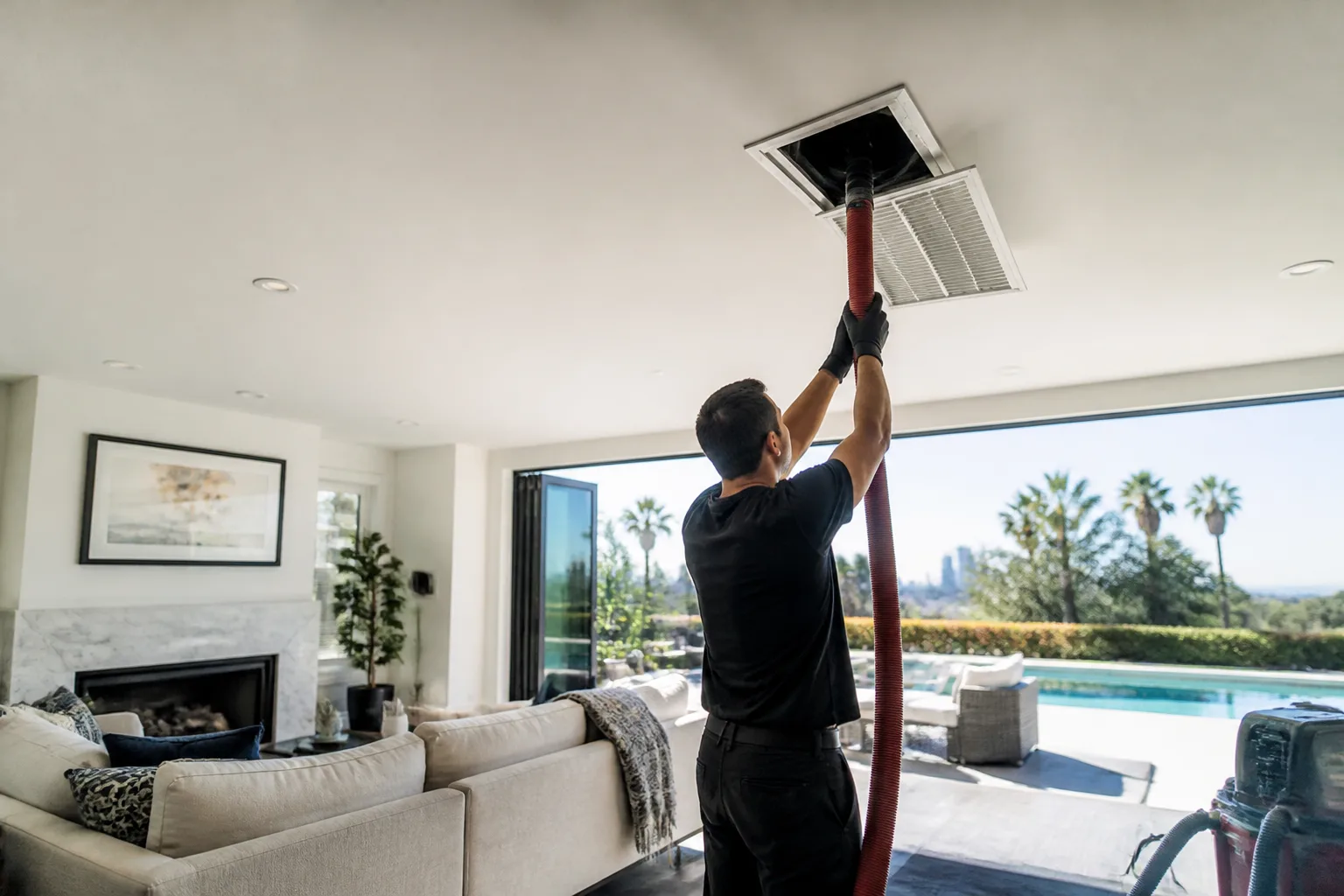
In Air Duct Cleaning in Los Angeles, we run a negative-air extraction setup that pulls loosened debris out of the duct wall into a HEPA-filtered containment unit. That’s the proper way: dislodge with a rotary brush, then extract under negative pressure so nothing escapes into the living space. A box-store shop vac taped to a vent just stirs the dust around and blows it back into your bedrooms.
Once the ducts are clean, you can see the joints, the connections, the flex runs, and any obvious failures. Only then does the repair-or-replace question become real.
The Test Most Los Angeles Contractors Skip
Here’s the part nobody tells you: a visual inspection after cleaning is still not enough. The gaps that leak conditioned air are often pinhead-sized, hidden behind insulation, or located where a plenum meets a branch run. You cannot see a 15% leakage rate with a flashlight. You measure it.
Duct leakage testing, sometimes called duct blaster testing, works like this: a calibrated fan is sealed to the duct system at the air handler or a main return. The fan pressurizes the entire duct network and measures exactly how many cubic feet per minute of air escapes before it ever reaches a supply register. That number, divided by total airflow, is your leakage percentage.
California Title 24 sets the benchmark: new duct systems must leak less than 6% of total airflow. If your Los Angeles home tests between 6% and 15%, you’re above code but likely not bleeding money yet. Between 15% and 25%, you should evaluate repair. Above 30%, you’re paying to cool or heat your attic, and replacement becomes the honest recommendation. A $150 test that tells you your system is at 4% saves you from a $6,000 replacement quote based on nothing but age and a contractor’s hunch.
Repair Options Between Cleaning and Replacement
Most homeowners think the choice is binary: clean or replace. The reality is there’s a whole middle tier of repairs that can extend a duct system’s life by a decade or more, and they cost a fraction of replacement.
Mastic sealing at joints is the old-school fix and still one of the best. Technicians apply a thick, paste-like sealant to every accessible joint, connection, and plenum seam. Properly applied mastic hardens into a durable seal that stops small leaks permanently. It’s messy work, which is probably why so many contractors skip it in favor of quoting replacement.
Aeroseal is the newer option and it’s genuinely clever. A pressurized aerosol polymer is blown into the duct system. The particles stay suspended in the airflow until they reach a gap, where they collect, bond, and seal it from the inside. Aeroseal handles the leaks you can’t reach: the ones inside walls, under slab, or behind finished ceilings. It’s not cheap, usually running $1,500 to $3,500 depending on system size, but it’s far less than a full replacement.
Flex duct section replacement addresses the LA-specific failure mode: flex runs that have degraded, torn, or disconnected in the attic. You don’t always need to replace the entire system. Sometimes two or three failed runs are the whole problem, and swapping those sections resolves the leakage without touching the main trunk line.
What Los Angeles Attics Do to Ductwork
If your ducts live in an unconditioned attic, and most Los Angeles homes route them there, your ductwork ages faster than coastal zip codes. San Fernando Valley attics regularly hit 140°F or higher in August. That heat bakes the outer jacket of flex duct until it turns brittle and cracks. The inner liner separates from the insulation. Connections that were snug when installed loosen as the plastic expands and contracts through daily temperature swings.
We’ve pulled flex runs out of Valley attics where the outer jacket crumbled in our hands like dried newspaper. The homeowner had no idea because the damage was hidden above the insulation and behind the duct’s own sag. A pressure test would have caught the leakage immediately. Instead, they’d been running a 4-ton AC unit for two summers while a third of the air it produced never reached a single room.
Coastal Los Angeles homes don’t escape the problem either, though the mechanism differs. Moisture and salt air accelerate corrosion on metal duct connections, and the marine layer keeps surfaces damp enough for mold on the interior of poorly sealed systems. Different climate, same result: leakage and contamination.
What a Written Price Should Actually Look Like
Here’s where Los Angeles homeowners get taken advantage of. A contractor shows up, spends twenty minutes in your attic, comes down shaking his head, and says you need a full replacement. He quotes $8,000. Maybe he’s right. Or maybe he’s selling a replacement because it’s a bigger invoice than a repair.
You can’t know the difference without a pressure test. A contractor who recommends replacement without measuring leakage is not giving you information. He’s giving you a sales pitch.
At Kestrel, written pricing is the standard on every job under the Kingswell Guarantee. That means the price is in your hands before a single vent is touched. No door-step revisions, no additions after the work is half done, no “I found something else while I was up there” surprises. The Done Right Promise backs every job in writing: if it’s not done right within the guarantee period, we return and make it right at no charge. That applies to repairs, and it applies to the cleaning itself.
We run Rotobrush rotary brush systems for agitation, Nikro negative-pressure units for extraction, and Abatement Technologies HEPA filtration when we’re doing a cleaning that involves asbestos or significant contamination concerns. If you’re investing in better indoor air after the work is done, Honeywell and Aprilaire make filtration products we’ve seen hold up well in LA homes between service visits.
The Decision Sequence That Makes Sense
So here’s the order of operations, stripped of sales pressure:
- Step 1: If you haven’t had the ducts cleaned in 5+ years, clean them first. Most LA homes carry a decade of dust, and you can’t evaluate what you can’t see.
- Step 2: After cleaning, get a duct leakage test. A $150 diagnostic beats a $6,000 guess every time.
- Step 3: If leakage is under 15%, you’re done. Run the system, replace the filter, move on.
- Step 4: If leakage is 15-25%, repair makes sense. Mastic sealing at accessible joints, Aeroseal for hidden leaks, and flex section replacement for failed runs.
- Step 5: If leakage is above 30%, replacement is the honest call. But now you have a number to justify the expense, not just a contractor’s word.
And one hard rule: if a company recommends replacement without offering or performing a leakage test, get a second opinion.
When to Call a Pro
Duct leakage testing requires a calibrated fan, a pressure gauge, and someone who knows how to interpret the results. Mastic sealing in a 130°F attic is not a weekend DIY project. Flex duct replacement involves working around electrical runs, plumbing, and insulation while properly connecting new sections to existing plenums. None of this is beginner territory.
If you’re in Los Angeles and want an honest answer about whether your ducts need cleaning, repair, or replacement, we can help. We’ll test, we’ll show you the numbers, and we’ll give you a written price before any work starts. We answer the phone with a live person, day or night, and our technicians are background-checked and uniformed. Related services: Air Duct Cleaning in Los Angeles and Dryer Vent Cleaning in Los Angeles.
The Bottom Line
The repair-or-replace decision for Los Angeles ductwork comes down to one number: leakage rate. Clean first so you can see the system clearly. Test so you know what’s actually failing. Repair when the leakage falls in the 15-25% range, using mastic sealing, Aeroseal, or flex section replacement. Replace above 30%. Ignore anyone who skips the test and jumps to a replacement quote. If you need help, Kestrel Air Duct Cleaning home offers free estimates. Call (469) 972-3151 and we’ll talk through your situation honestly.
Frequently Asked Questions
A duct leakage test in Los Angeles typically runs $150 to $300 depending on system size and accessibility. It takes under an hour and tells you whether your ducts are leaking 5% or 35% of your conditioned air. That’s the single most useful diagnostic number before any repair or replacement decision. Call (469) 972-3151 for an exact quote, estimates are free.
The only reliable way is a duct leakage test after cleaning. Under 15% leakage, your system is fine. Between 15% and 25%, repair is appropriate. Above 30%, replacement typically makes financial sense because you’re paying to condition your attic. Visual inspection alone cannot determine this, no matter how experienced the contractor.
Metal duct trunks can last 40 to 50 years with proper sealing and maintenance. Flex duct in unconditioned Los Angeles attics typically degrades faster, often needing section replacement after 15 to 20 years because extreme heat cycles crack the outer jacket and loosen connections. Coastal moisture adds corrosion risk for metal systems.
Clean first. You can’t evaluate joint condition, connection tightness, or flex duct integrity through a layer of accumulated dust and debris. A proper cleaning reveals what’s actually there, and then the leakage test gives you the numbers to make an honest repair-or-replace decision. Skipping straight to replacement without cleaning and testing is how homeowners end up replacing ducts that just needed a thorough cleaning and minor sealing.
Written by the team at Kestrel Air Duct Cleaning.
Need Air Duct Cleaning Help?
Call Kestrel Air Duct Cleaning - licensed & insured, here with fast after-hours help in Los Angeles.
(469) 972-3151