
Questions to Ask Before Hiring a Air Duct Cleaning Company
A good air duct cleaning company will answer direct questions with direct answers, in writing, before you spend a dollar. Most homeowners ask about license and price, which matters, but the questions that actually expose a bad contractor are about the written estimate, the equipment’s CFM rating, the guarantee’s remedy, and who exactly shows up at your door. If you’d rather skip the homework and talk through it now, call (469) 972-3151.
The truth is that anyone can print “licensed and insured” on a flyer. Fewer can tell you their negative-air machine moves 2,200 cubic feet per minute, and fewer still will put the final price in writing before a single vent cover comes off. Those two differences explain most horror stories we hear in Los Angeles.
Question 1: Can I Get the Written Estimate Before Scheduling, Not After the Inspection?
This is the single most revealing question you can ask, and almost nobody asks it.
You’ll hear some version of “well, we have to see the system first” or “every home is different.” That sounds reasonable until you understand the pattern. A contractor who insists on inspecting before quoting has created a situation where you’ve already taken time off work and they’re standing in your hallway. The price that follows has nothing anchoring it to what you were told on the phone.
Ask for the written estimate before you schedule. Every legitimate air duct cleaning company in Los Angeles can quote a firm range over the phone based on square footage, number of vents, and system type. If they refuse, you’re not hearing about a limitation of the trade. You’re hearing about their sales process.
In our company, the written price lands in the customer’s hands before a single panel is touched. No exceptions. That commitment comes from the Kingswell Guarantee, the standard that’s governed every job. The estimate you approve is the price you pay.
Question 2: What Cleaning Method Do You Use and What’s the CFM Rating on Your Equipment?
Here’s where you separate real equipment from a glorified shop vac.
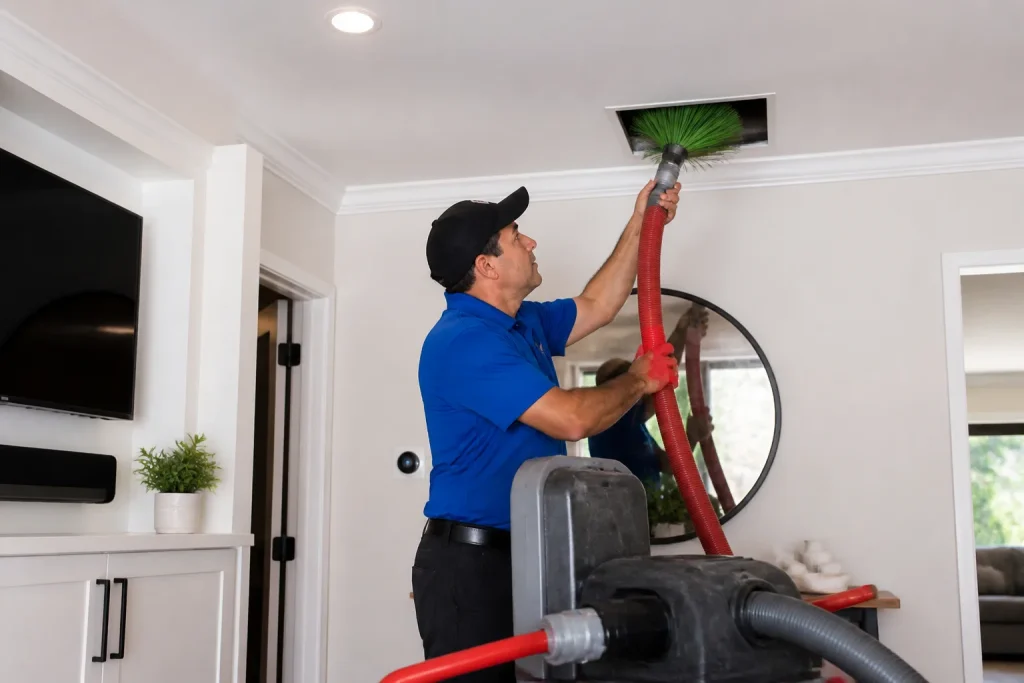
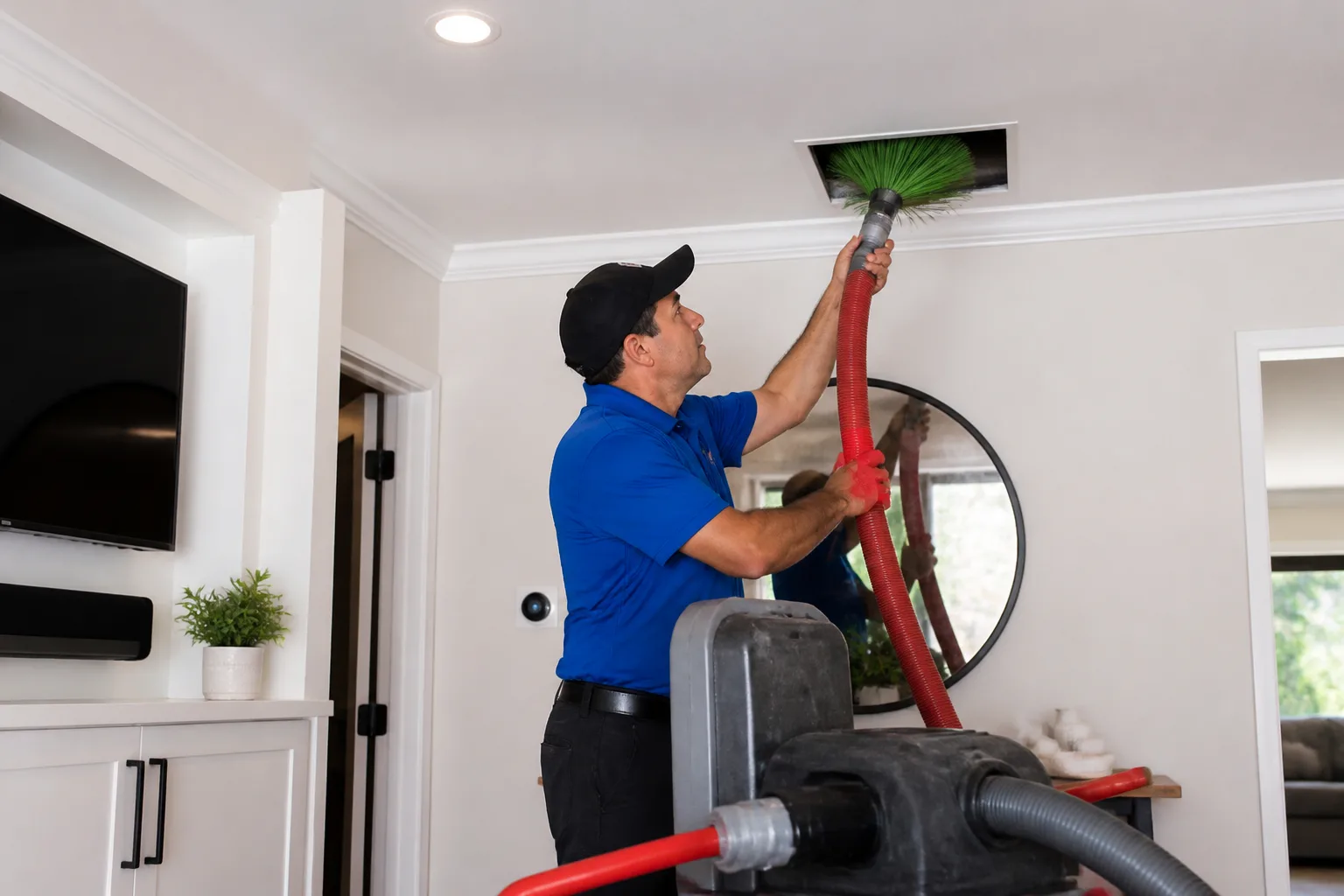
A proper air duct cleaning uses negative-air extraction. That phrase means a vacuum unit connects to your ductwork and pulls the entire system under negative pressure, so debris loosened during cleaning gets captured into the machine rather than blown back into your living room. Brush agitation, usually through a rotary brush system like Rotobrush, dislodges the debris stuck to the duct walls. The extraction unit then removes it.
The number you want to hear is the CFM rating. That’s cubic feet per minute, the measure of how much air the extraction unit actually moves. A portable vacuum might move 200 to 400 CFM. That’s not enough to pull debris from the far end of a 2,000-square-foot home’s duct run. Professional negative-air units, like the Nikro systems we run, move 2,000 CFM or more. Ask the number. If they can’t tell you, they’re using equipment they don’t understand.
HEPA filtration matters too. Abatement Technologies HEPA filters capture the sub-micron particles that would otherwise escape the cleaning process. A company using this equipment can explain all three pieces: the brush that agitates, the vacuum that extracts, and the filter that contains. A company that can’t is relying on your unfamiliarity with the trade.
Question 3: What Does the Guarantee Cover in Writing, and For How Long?
“100% satisfaction guaranteed” is the emptiest phrase in home services. Ask what happens when you’re not satisfied.
A real guarantee names the remedy. It says something like: if the work fails within the stated period, we return and make it right at no charge. It defines what qualifies as a covered problem. It tells you what you need to do to invoke it. It’s written on the invoice or the estimate, not described vaguely over the phone.
Our company operates under the Done Right Promise. If the work falls short within that year, we come back and correct it at no charge. That’s not a courtesy we extend when we feel like it. It’s in writing on every job. We also commit to a free return visit if the cleaning fails within the guarantee period.
In Los Angeles, where summer heat pushes dust through systems constantly, a guarantee that covers less than a full year doesn’t account for the seasonal cycle. You want to see how the system performs through a Santa Ana season and a rainy winter. A written promise covers that.
Question 4: Who’s Actually Showing Up? A W-2 Employee or a Day-Labor Subcontractor?
Most people never think to ask this. They should.
A subcontractor paid by the job has no long-term relationship with the company whose name is on the invoice. If the cleaning is rushed, if a vent cover gets broken, if the dryer vent reclogs six weeks later, the accountability chain is murky. The company blames the subcontractor. The subcontractor is already on the other side of town.
Ask directly: are your technicians W-2 employees? Are they background-checked? Do they wear uniforms? Do you train them on your standards or just dispatch whoever’s available?
We run background-checked, uniformed technicians who operate under a specific code we call the Kingswell Way. It governs five things on every visit: say the price, show up in the window we gave, leave the place cleaner, put the guarantee in writing, and come back if it fails. That code only works if the person in your home answers to us directly. A day-labor arrangement can’t carry a real code.
Question 5: What’s My Arrival Window and What Happens If You Miss It?
“Between 8 and noon” is not a commitment. It’s a suggestion disguised as one.
Ask for the specific window in writing and then ask the follow-up: what happens if you miss it? A company that treats punctuality as a real standard will have an answer. Maybe it’s a discount. Maybe it’s priority rescheduling. Maybe it’s simply that they track their own performance and miss windows rarely enough that the question surprises them.
A company that treats the arrival window as a polite estimate will get vague or defensive. That tells you more than any online review.
The Kingswell Guarantee includes a defined arrival window as one of its four written promises. The price is written. The window is written. The clean job site is written. The guarantee is written. All four matter, but the window is the one that shows up in your daily life first.
Question 6: What Won’t You Do, and What Might Cost Extra?
This is the question bad contractors hate most because it forces honesty in advance.
Ask what the quote does not include. Mold remediation? That’s not duct cleaning and should be handled separately. Sanitizing fog? Some companies push it as an upsell. Rodent debris removal? That’s biohazard work, not routine cleaning. A legitimate company will tell you plainly what the cleaning covers and what additional work, if any, applies to your situation.
Also ask whether the price can change once the technician sees the system. The answer should be a flat no for a standard system, with the caveat that genuinely unusual conditions get discussed before work proceeds, not after.
We quote one flat price per system. It’s agreed before work starts. If there’s a legitimate issue that changes scope, it gets discussed and approved before we touch anything. The price never surprises you at the door.
Why These Questions Matter More in Los Angeles
Los Angeles homes face specific air-quality pressures that make thorough duct cleaning more valuable here than in most markets. Wildfire smoke from the surrounding hills settles into ductwork. Marine layer moisture near the coast contributes to the kind of damp dust that clings to duct walls rather than blowing through. And because L.A. homes run air conditioning for months at a stretch, the accumulated debris in the system recirculates on every cycle.
Those conditions reward honest, thorough work and punish corner-cutting. A company running adequate negative-air extraction with HEPA filtration will leave your system measurably cleaner. A company with inadequate equipment will knock loose enough debris to look busy and leave the rest stuck to the duct walls, where it’ll break free over the following weeks.
In our experience, the homes that need the most attention are the ones that haven’t been cleaned in years and don’t look dirty from the outside. The visible vent grime is usually the smallest part of what’s actually in the system.
When to Call a Pro
Air duct cleaning is not a do-it-yourself project. The tools that make it work are commercial-grade: rotary brush systems that reach the full duct run, negative-air extraction units that pull the entire system under suction, and HEPA filtration that keeps loosened contaminants out of your living space. A household vacuum can’t generate the airflow to pull debris from a duct run that stretches from a garage furnace to a second-story register.
There’s also a real understanding of system design involved. You need to know where the access points are, how the return plenum connects, how the registers seat, and how to seal the system when you’re done. Getting any of that wrong leaves you with loose debris, damaged ductwork, or an HVAC system that never quite works the same again.
The point of the questions above isn’t to prepare you to do it yourself. It’s to make sure the company you hire has the equipment, the commitment, and the accountability to do it right the first time.
Related Services in Los Angeles
This article is about air duct cleaning, but the same questions apply to dryer vent cleaning. A clogged dryer vent is a fire hazard that builds slowly, and the reputable cleaning companies in Los Angeles apply the same standards to dryer vents that they do to full duct systems.
For more detail on air duct work in the area, see our Air Duct Cleaning in Los Angeles page. For dryer-specific guidance, our Dryer Vent Cleaning in Los Angeles page covers the same ground from the laundry room’s perspective.
What happens when you call
- 1
A real person answersNo phone trees - you reach a local pro.
- 2
You get an upfront price rangeHonest numbers before anyone is dispatched.
- 3
A background-checked tech heads outLicensed & insured, dispatched right away.
- 4
You approve before work beginsNothing starts until you say go.
The Bottom Line
The right questions get you the right company. Ask for the written estimate before scheduling. Ask for the CFM rating on the extraction equipment. Ask what the guarantee covers in writing and for how long. Ask whether the technician is an employee or a subcontractor. Ask what happens if the arrival window gets missed. Ask what’s not included and what could change the price.
The answers to those questions will tell you everything you need to know. A company like Kestrel Air Duct Cleaning home answers all of them directly, in writing, before any work begins. You don’t have to take our word for any of it. Call and ask the questions yourself. If you’re in Los Angeles and ready for a straight answer, call (469) 972-3151 for a free estimate. We’ll put the price in writing before a single vent cover moves.
Frequently Asked Questions
How much does air duct cleaning cost in Los Angeles?
Most Los Angeles homes run between $400 and $800 for a full-system cleaning, depending on square footage, number of vents, and how long it’s been since the last cleaning. Larger homes or systems with heavy buildup can exceed that range. Call (469) 972-3151 for an exact quote, and we’ll put the final price in writing before any work begins.
Why are some air duct cleaning quotes so much cheaper?
Because some companies use portable vacuums that can’t generate enough airflow to clean the full duct run. The low price reflects inadequate equipment and a rushed job. Ask any cheap quote for the CFM rating on their extraction unit. If it’s under 1,000, the price isn’t a bargain. It’s a preview of what a partial cleaning costs.
How do I know the work was actually done?
Ask for before-and-after photos of your own ducts, not a stock image from the company’s website. At Kestrel, our technicians photograph the system interior at the access points before and after cleaning, so you can see the duct walls, not just a clean vent cover. That’s part of the Kingswell Way on every visit
How often does air duct cleaning really need doing?
Most homes benefit from a full cleaning every three to five years, more often if you have pets, live near wildfire zones, or run the air conditioning heavily. In Los Angeles, we recommend an annual visual check and a full cleaning when the buildup becomes visible at the register or the airflow drops noticeably. Call (469) 972-3151 if you’re not sure where your system stands.
Written by the team at Kestrel Air Duct Cleaning.
Need Air Duct Cleaning Help?
Call Kestrel Air Duct Cleaning - licensed & insured, here with fast after-hours help in Los Angeles.
(469) 972-3151