
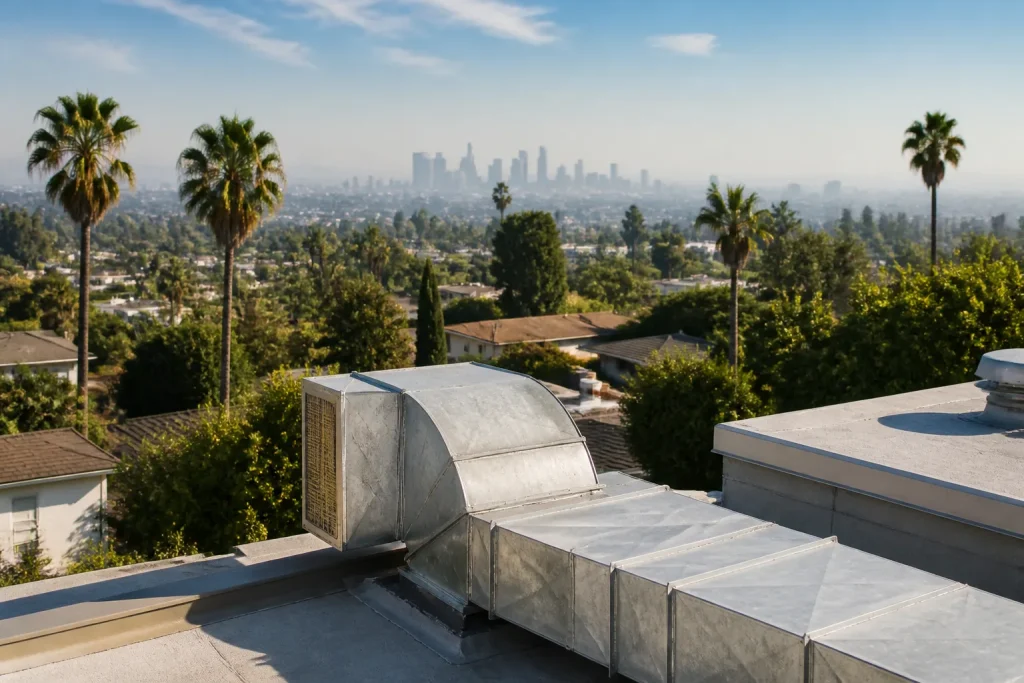
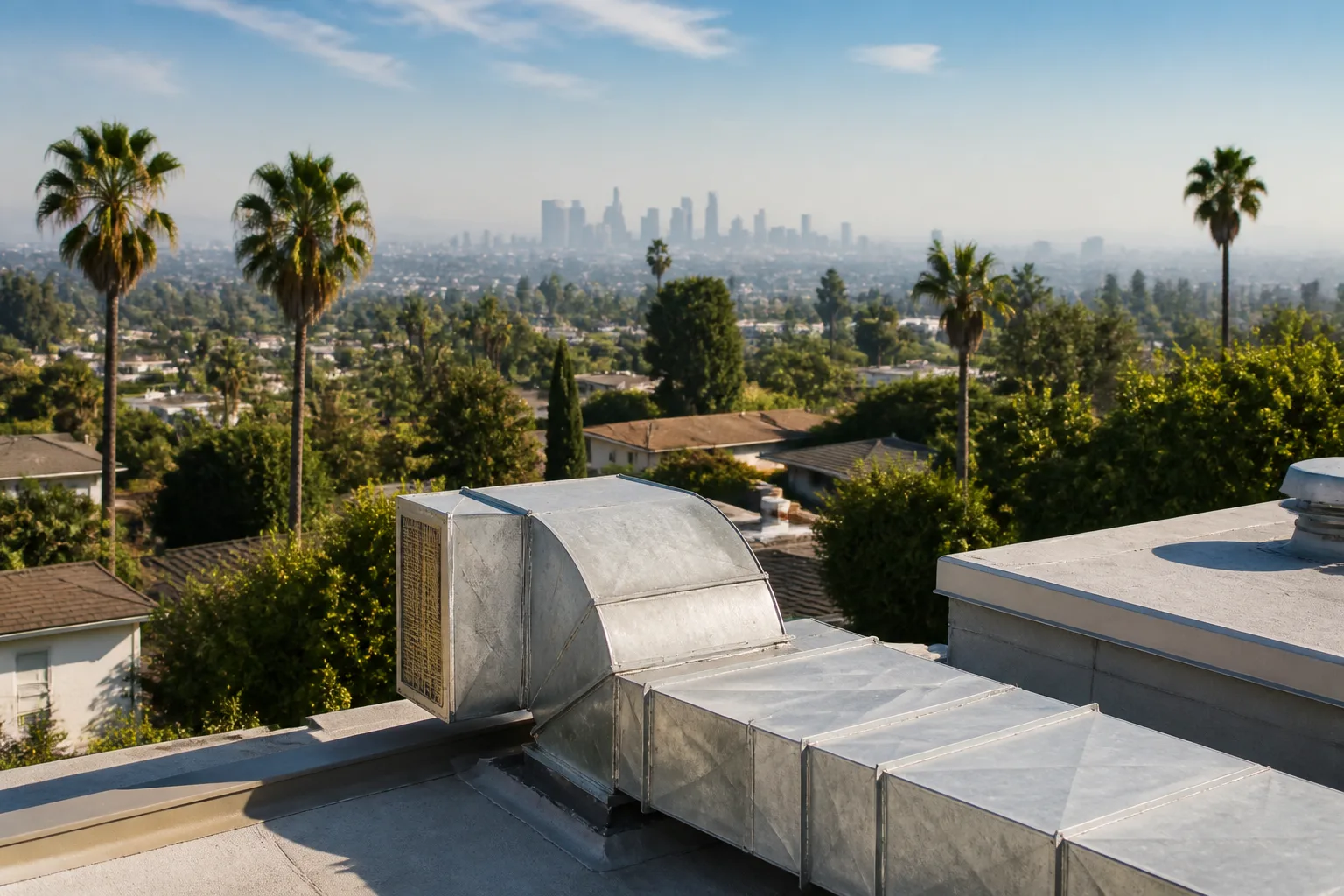
How Los Angeles Weather Affects Your Air Duct Cleaning
Los Angeles weather changes what’s inside your ducts faster than almost any city in the country. Santa Ana winds can deposit a visible layer of fine dust and ash in return grilles within 48 hours, marine-layer humidity cycles can trigger condensation inside duct insulation in coastal homes, and wildfire smoke introduces submicron particles that standard cleaning methods won’t fully address without pre-testing. If you’re tracking your duct cleaning schedule by the calendar instead of by weather events, you’re probably waiting too long. Or not long enough, depending on where in LA you live.
We’ve been cleaning ducts in Los Angeles, and the single biggest mistake we see is homeowners treating duct cleaning like an oil change: something you do at a fixed interval, no matter what. But LA doesn’t work that way. A house in Woodland Hills might need its ducts cleaned three times before a house in Torrance needs it once. The difference is weather, and more specifically, which weather events hit your block. If you’d rather not track any of this yourself, call (469) 972-3151 and we’ll walk you through it.
Key Takeaways:
- Santa Ana winds can contaminate ducts in 48 hours, not 3 – 5 years
- Marine-layer humidity causes condensation inside attic duct insulation in coastal neighborhoods
- Wildfire smoke introduces particles under 1 micron that require specialized filtration during cleaning
- Drought conditions in Southern California triple the fine-particle load your return system pulls in
- Track your cleaning schedule by weather events, not calendar dates
Santa Ana Winds: The 48-Hour Contamination Event
Most national duct-cleaning guidance assumes dust builds up gradually over months and years. That’s true in Chicago or Boston. It is not true in Los Angeles during Santa Ana season, which runs from September through March and peaks in October and November.
Santa Ana winds form when high pressure builds over the Great Basin and pushes air down through the canyons toward the coast. That air compresses as it descends, which heats it up and strips out moisture. Relative humidity can drop below 10 percent while wind speeds hit 40 to 60 mph, with gusts over 70 mph in passes like the Cajon and Soledad. The result is a hot, dry, fast-moving river of air that picks up everything loose in its path: dust from the high desert, pollen from the foothills, and, during fire season, ash and partially combusted organic material.
Here’s what that means for your ducts. Your HVAC return system pulls air from inside your home, but your home isn’t sealed. Gaps around windows, doors, can lights, and attic hatches let outdoor air in. During a Santa Ana event, that infiltrating air carries a much higher particle load than normal. Your return grilles pull those particles through the duct system, and a meaningful fraction of them stick to the duct walls, especially where the duct turns or where static pressure drops.
We’ve opened access panels in Sherman Oaks two days after a wind event and found what looks like six months of normal accumulation. Fine, gray-brown powder coating the inside of the return plenum. That’s not gradual dust buildup. That’s an acute contamination event, and it changes the calculus on when to clean. A homeowner who tracked air quality data and saw a single day at 150+ AQI should inspect their ducts that week, not wait for year three of a five-year cycle.
The Marine Layer: Humidity Cycling and Duct Condensation
If you live west of the 405, or especially within a few miles of the coast, your ducts face a problem that’s nearly invisible until it’s expensive. The marine layer is a daily humidity cycle. Warm, dry air sits above a shallow deck of cool, moist ocean air. That deck thickens at night and retreats in the afternoon. Coastal neighborhoods like Venice, Playa del Rey, El Segundo, and San Pedro experience relative humidity swings from 80 percent at 6 a.m. down to 40 percent by 3 p.m., then back up again after sunset.
Inside duct systems, that cycling matters. Most Los Angeles homes run flex duct in unconditioned attics, where daytime attic temperatures can exceed 140°F in summer. When humid marine air infiltrates the attic and meets duct insulation that’s been cooled by air conditioning air moving through the duct core, condensation can form on the outer surface of the insulation. Over time, that moisture works its way inward. We’ve opened supply plenums in Long Beach and found the fiberglass insulation inside the duct damp to the touch, with a faint musty odor you’d never notice from inside the living space.
Condensation inside duct insulation does three things, none of them good. First, it degrades the insulation’s R-value, which forces your AC to work harder. Second, it creates conditions where dust sticks to duct walls instead of blowing through, turning what would be a thin film into a caked layer. Third, it can support mold growth if conditions persist. That’s why a duct cleaning in coastal LA should include a visual inspection of the insulation itself, not just a pass with a rotary brush. We use Abatement Technologies HEPA-filtered negative-pressure units specifically because they contain what the brush kicks loose, which matters more when moisture has glued debris to the duct wall.
Wildfire Smoke: Why Standard Cleaning Isn’t Always Enough
Wildfire smoke is chemically different from household dust. Household dust is mostly skin cells, textile fibers, pet dander, and tracked-in soil. Most of those particles are relatively large, 10 microns and up, and your standard filter handles them.
Wildfire smoke particles are not that. Smoke from burning structures, as we saw in the LA-area fires, contains particles under 1 micron in diameter, plus volatile organic compounds (VOCs) and polycyclic aromatic hydrocarbons (PAHs) from combusted building materials and vegetation. Submicron particles don’t just settle in your ducts. They stay suspended in air, then adhere to any surface they touch, including the oil residue already coating the inside of your ductwork. That’s why after a major smoke event, the inside of a return duct can feel slightly tacky to the touch.
Here’s what we tell homeowners in Los Angeles after a significant fire season. If you lived near a burn area, or if your neighborhood had multiple days of AQI over 150, a standard duct cleaning may not be sufficient. The right approach starts with an inspection: a technician looks inside the plenum and the first few feet of ductwork to assess whether smoke residue is present. If it is, the cleaning needs a HEPA-filtered negative-air setup. We run Rotobrush rotary brush systems paired with Nikro negative-pressure units, and for smoke-contaminated systems we add Abatement Technologies HEPA filtration on the exhaust side so the submicron particles we dislodge don’t get blown back into the living space. Your living room does not need a second dose of what the Santa Anas already delivered.
Drought-Driven Dust: The Slow Accumulator
Southern California has cycled through multi-year drought conditions for most of the past two decades. Drought does something specific to duct contamination: it dries out soil and vegetation, which produces more airborne fine particles, which means the outdoor air your house pulls in is simply dirtier than it was during wetter years. This is measurable. Long-term air quality data for the Los Angeles basin shows higher average PM10 and PM2.5 concentrations during drought years, even without wildfire events.
Your HVAC system doesn’t know the difference between a dust storm and a dry year. It pulls return air, runs it through a filter, and sends it into the living space. If the ambient outdoor particle load is higher, the amount that makes it into your ducts is higher. The filter catches what it catches, and the rest either settles in the ducts or circulates through the house. Over a dry two-year stretch, the accumulation rate inside ductwork climbs noticeably.
We see this in the field. Homes in the San Fernando Valley, where drought conditions produce especially dry soil and a lot of landscaping that goes dormant and dusty, tend to have heavier duct accumulation than homes closer to the coast during the same period. Same house size, same filter, same occupants. The difference is what’s coming in through the return-air path. If you’ve lived through a multi-year Southern California drought and you haven’t looked inside your ducts, the odds are good that the duct walls look like the floor of a garage that hasn’t been swept in a while.
Tracking Your Duct Cleaning Schedule by Weather, Not Calendar
The standard advice, clean every 3 – 5 years, was not written for a city where a single October wind event can push fine ash through every return grille in the house overnight. So here’s a better approach for Los Angeles homeowners.
Keep a simple log. You don’t need professional monitoring equipment. You need three things: your local AQI reading (available free on AirNow.gov or any weather app), a note when a Santa Ana event hits your area, and a note when fire season produces smoke days in your county. Then apply this rough guide:
- One or more Santa Ana wind events with AQI over 100: Inspect your return grilles within one week. If you see visible dust lines on the grille face or dust buildup inside the return duct, schedule a cleaning.
- Multiple days of AQI over 150 from wildfire smoke: Schedule an inspection even if you can’t see obvious residue. Submicron smoke particles don’t always show up as visible dust.
- Coastal home with no major wind or smoke events: Standard 3 – 5 year cleaning cycle is probably fine, but include a visual check of duct insulation for moisture at year three.
- Inland home through a drought year: Consider moving your cleaning cycle to every 2 – 3 years. Drought dust is real, and it accumulates faster than most people realize.
If that feels like a lot to track, it’s about ten minutes of attention per month. Compare that to running a system with restricted airflow, which costs you money on your energy bill and circulates the stuff you don’t want to breathe. When in doubt, call a professional and have someone look. We’d rather tell you it’s not time yet than open a plenum that should have been cleaned eighteen months ago.
When to Call a Pro
Some duct maintenance you can handle yourself: changing filters regularly, vacuuming the return grille faces, keeping furniture off supply registers. But the work inside the ducts is where a professional makes the difference. We use Rotobrush rotary brush systems for one reason: they dislodge debris that a shop-vac simply can’t reach. A box-store vacuum has no agitation. It pulls what’s loose and leaves what’s stuck. A rotary brush with negative-pressure extraction gets the caked material off the duct wall and removes it from the system.
If your home has been through a notable weather event, or if you’re in a coastal Los Angeles neighborhood and suspect moisture in the duct insulation, call someone who can open a panel and tell you what’s actually happening. That’s what we do. And we put the price in writing before any work starts, so you’ll know the number before the first vent is touched.
Related services in Los Angeles: Learn more about our Air Duct Cleaning in Los Angeles or read about Dryer Vent Cleaning in Los Angeles. For an overview of who we are and how we work, visit the Kestrel Air Duct Cleaning home page.
The Bottom Line
Los Angeles weather doesn’t wait for your cleaning schedule. Santa Ana winds deliver acute contamination in a weekend. Marine-layer humidity creates slow, invisible moisture problems near the coast. Wildfire smoke introduces particles your standard filter never touches. Drought years quietly raise the outdoor particle load your system pulls through every single day. None of this appears in generic national duct-cleaning guidance, and all of it affects homes in Los Angeles differently depending on whether you’re in Sherman Oaks, Long Beach, or San Pedro.
Our advice: track by weather event, not by calendar. And when you need a look inside, call Kestrel Air Duct Cleaning at (469) 972-3151 for a free estimate. We’ll show you what’s actually in there, quote you a written price before work begins, and back the cleaning with a Done Right Promise in writing.
Frequently Asked Questions
It depends on your neighborhood and the weather events your home has been through. Coastal homes with no major wind or fire events can follow the standard 3 – 5 year cycle. Inland homes, especially in the San Fernando Valley, often need cleaning every 2 – 3 years during drought years. After a significant Santa Ana wind event or wildfire smoke days, inspect your ducts immediately rather than waiting for the next scheduled cleaning. Call (469) 972-3151 and we can help you figure out what your home actually needs.
Yes. Santa Ana winds drop humidity below 10 percent and push fine particulate from the high desert and foothills into the Los Angeles basin. That air infiltrates homes through gaps around windows, doors, and attic hatches, then gets pulled through the return system. We’ve opened ducts two days after a wind event and found accumulation that looks like months of normal buildup. If you had a Santa Ana event with AQI over 100, check your return grilles that week.
Wildfire smoke leaves submicron particles and chemical residue inside ductwork that household dust doesn’t. Those particles adhere to the oily film already present in most ducts and can leave the surface feeling slightly tacky. Standard cleaning without HEPA-filtered negative-pressure containment won’t fully address smoke residue. If you’ve had multiple days of AQI over 150 from smoke, schedule an inspection before the next fire season starts. Call (469) 972-3151 for a free estimate.
Proximity to the coast, elevation, and local wind patterns all change what enters your ducts. Coastal homes deal with marine-layer humidity cycling that can cause condensation inside attic duct insulation. Inland homes deal with drought-driven dust and heavier Santa Ana exposure. Homes near burn areas deal with smoke. A house in Woodland Hills and a house in Torrance will have different contamination profiles, which is why the calendar is the wrong metric. Track your weather events and inspect accordingly.
Written by the team at Kestrel Air Duct Cleaning.
Need Air Duct Cleaning Help?
Call Kestrel Air Duct Cleaning - licensed & insured, here with fast after-hours help in Los Angeles.
(469) 972-3151