
5 Mistakes to Avoid With Dryer Vent Cleaning
Every year, homeowners in Los Angeles make the same five mistakes with dryer vent cleaning, and most of them don’t realize it until the dryer takes 90 minutes to dry a single load or the vent cap outside stops opening. These mistakes turn a straightforward maintenance task into a fire risk or a wasted service call. The good news: each one is avoidable once you know what to look for. If you’d rather not deal with it yourself, call us at (469) 972-3151 and we’ll handle the whole thing.
Here’s the reality most people never hear: lint is the second most common material found at residential fire origins in California. And the homeowners whose dryers started those fires almost all thought their vent situation was fine, because the dryer was still running. That’s the thing about dryer vents. They don’t announce failure. They just get hot, slow, and eventually dangerous. We’ve been cleaning vents in Los Angeles, and the same five mistakes show up in house after house.
Key Takeaways
- Cleaning only the accessible pipe section misses roughly 80% of the lint in your duct run.
- A leaf blower is not a cleaning tool. It compresses lint deeper into the duct.
- Foil flex duct should be replaced after cleaning, not reinstalled, if it shows any internal damage.
- The exterior vent cap must open freely or the whole job was pointless.
- Any major lint event, a forgotten tissue load, a clogged trap, a new dryer, means it’s time to clean again.
Mistake #1: Cleaning Only the Accessible Section of the Vent
The most common mistake we see in Los Angeles homes is also the most dangerous, because it feels productive. You disconnect the dryer, maybe run a brush a few feet into the pipe, vacuum up what falls out, and call it done. But the four-inch elbow behind the dryer is just the entrance. The real accumulation happens in the wall run, where the duct travels between floors, through the attic, or across the garage ceiling. In our experience, that accessible section represents maybe 20% of the total duct length. The other 80% is where lint compresses into sheets against the duct wall, decade after decade, until the opening is the size of a silver dollar.
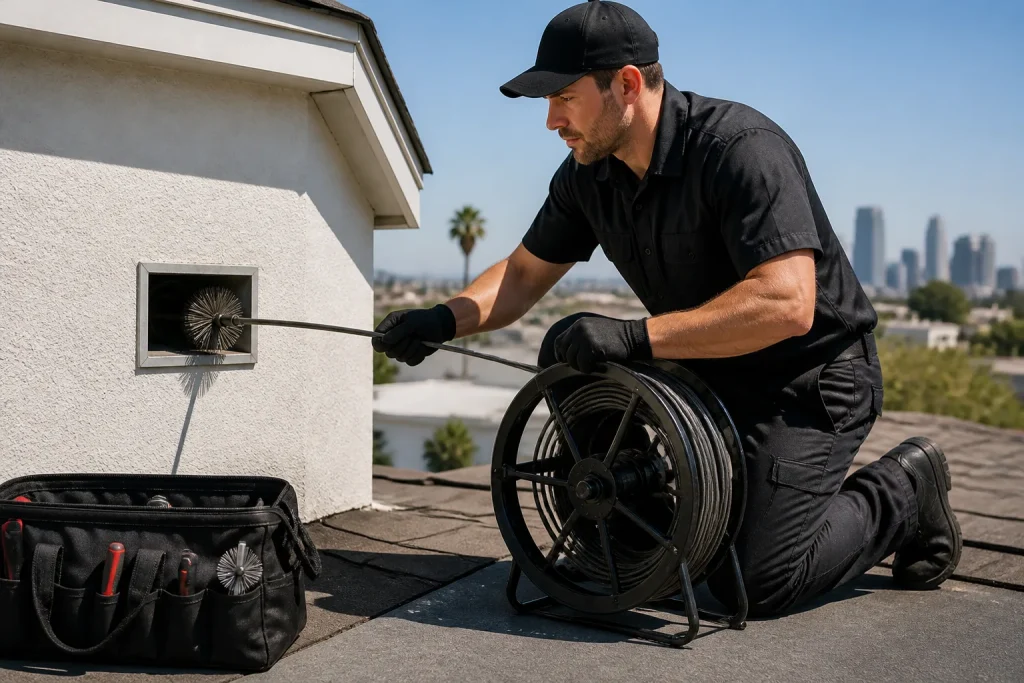
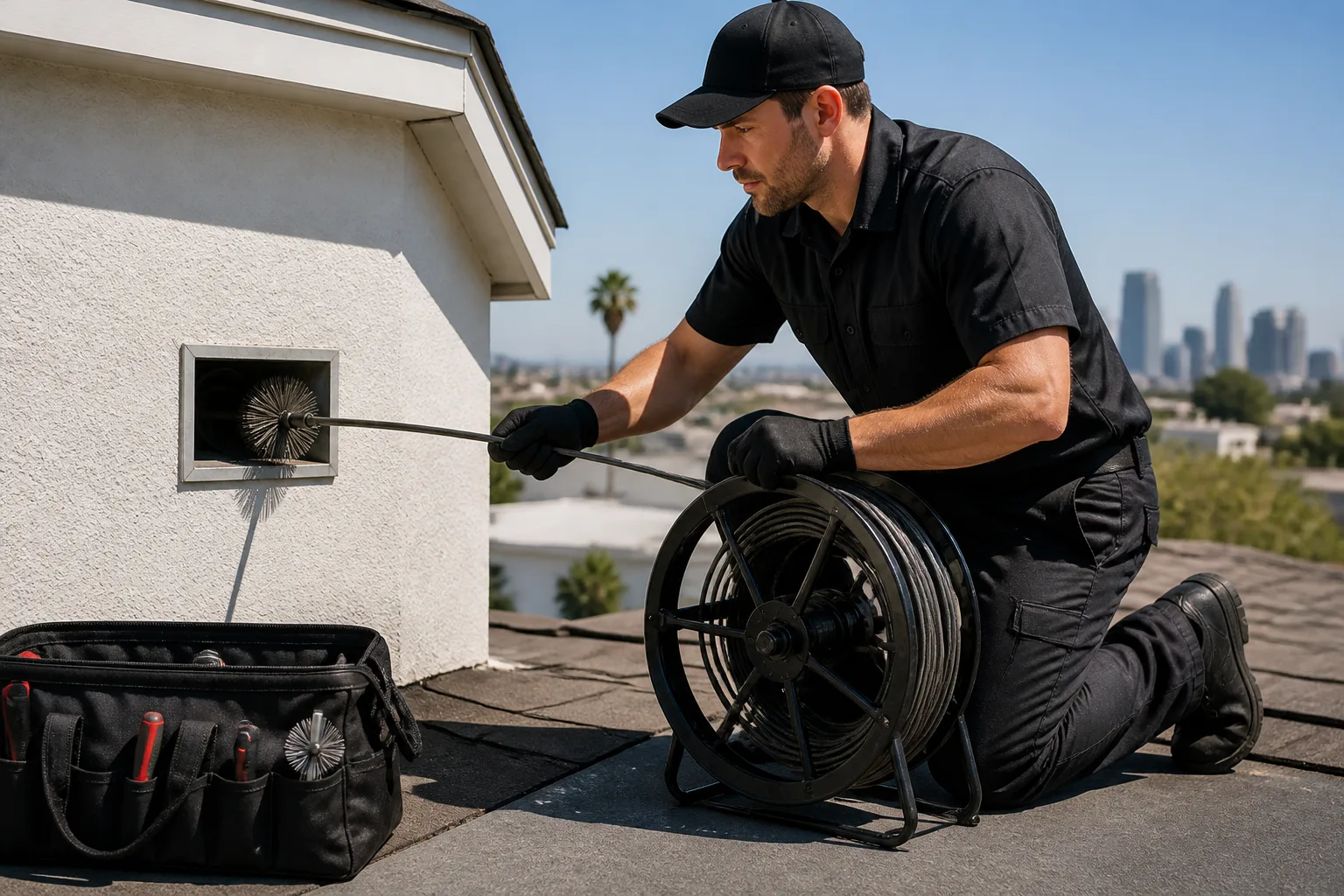
Most DIY kits from the hardware store simply can’t reach that far. The rods flex, they bend, and most homeowners stop pushing when they meet resistance. That resistance is usually the first elbow or the transition into the wall. So the job ends right where the real work begins. A proper cleaning with a rotary brush system, like the Rotobrush equipment our Dryer Vent Cleaning in Los Angeles team uses, runs the full length of the duct from the dryer connection to the exterior termination. The brush tip agitates the duct wall while a negative-pressure unit pulls loosened lint out the other end. That’s the only way to clear the whole run, not just the part you can see.
If you’re going to attempt a cleaning yourself, know this: if your brush never reaches the outside vent cap, you haven’t cleaned the vent. You’ve cleaned a pipe stub. And the lint behind it is still there, drying out, getting hotter, and waiting for one more load of towels to push it past the point of no return.
Mistake #2: Using a Leaf Blower to “Blow Out” the Vent
This one makes sense on paper. The vent is a tube. A leaf blower moves air. Point one at the other and the problem disappears. But in practice, what a leaf blower does to a lint-clogged dryer duct is the opposite of cleaning. It compresses. Lint in a duct isn’t loose and fluffy. It’s layered, damp in places, and adhered to the duct wall. A leaf blower pushes against that mass with high volume but low pressure. The front layers pack tighter, the moisture traps more lint, and the obstruction gets denser rather than moving.
There’s another problem with the leaf blower approach in Los Angeles homes specifically. Many dryer ducts in older houses run through walls with flexible foil connectors at joints. A leaf blower’s blast, especially on a partially clogged duct, can create enough backpressure to separate those joints inside the wall. Now you have a disconnected duct pumping hot, humid air into a wall cavity, and you can’t see any of it. The dryer still runs. The clothes still dry, eventually. But the wall is collecting moisture and lint in a space you’ll never inspect.
Proper dryer vent cleaning uses negative-pressure extraction, which means air is pulled through the duct rather than pushed. Equipment like the Nikro units our technicians use pulls loosened debris out toward the exterior vent, keeping the duct interior under suction the whole time. Combined with brush agitation, this removes material instead of relocating it. If someone offers to clean your dryer vent with a leaf blower, the best response is a polite no.
Mistake #3: Reinstalling the Same Foil Flex Duct After Cleaning
Here’s a scenario we see regularly in Los Angeles: a homeowner or a budget technician disconnects the dryer, cleans the duct, and then reattaches the same old foil flex hose that was there before. The thinking is that the hose is just a connector. If it’s not torn, it’s fine. But foil flex duct has a fatal flaw: the corrugations. Every rib in that accordion-style wall is a lint trap. Even a perfectly cleaned flex hose starts collecting lint the moment air flows through it again, because the ribs interrupt the airflow and catch fibers.
Worse, foil flex is fragile. Birds peck at it from the outside. It kinks when the dryer gets pushed back against the wall. Once kinked, the interior diameter shrinks and the airflow drops permanently. You can clean that hose until it shines and it will still collect lint faster than a smooth, rigid metal duct. In our service, if we pull a flex hose off a dryer and it shows any kinking, internal damage, or bird damage, we recommend replacing it before we reconnect anything. A proper vent system uses rigid metal duct for the wall run, with minimal flex connectors limited to the immediate connection behind the dryer.
If you’re in Los Angeles and your dryer has been connected to the same flex hose for five years or more, replacing it is not an upsell. It’s the difference between a vent that stays clean for a year and one that re-clogs in six weeks.
Mistake #4: Not Confirming the Exterior Termination Cap Opens Freely
The exterior vent cap is the last stop for every cubic foot of air your dryer pushes out, and it’s the part most homeowners never look at. That’s a problem, because a clean duct with a stuck termination cap is a clogged vent in everything but name. If the damper flaps are jammed closed by lint, paint, or a bird’s nest, your dryer is pushing hot air into a sealed pipe. The heat backs up into the wall cavity, the dryer runs hotter and longer, and the lint that would have exited the house stays in the duct instead.
We check the termination cap on every job in Los Angeles because we’ve seen too many cases where the interior duct was spotless and the exterior cap was completely inoperative. In one house in Silver Lake, the homeowners had paid for a cleaning six months earlier. The interior duct was clean. But the outside cap was painted shut during a repaint, and nobody noticed. The dryer was taking 70 minutes per load and the wall behind the dryer was warm to the touch. That’s what a stuck cap does.
The exterior cap also matters because it’s the first line of defense against pests. A missing or damaged damper lets birds, rodents, and insects into the duct, and they bring nesting material that clogs the pipe faster than lint ever could. After any cleaning, the cap should open freely when the dryer runs and close fully when it stops. If it doesn’t, the cleaning wasn’t complete, no matter how good the interior work was.
Mistake #5: Skipping Cleaning After a Major Lint Event
This is the mistake that catches people by surprise, because the trigger doesn’t look like a vent problem. A tissue forgotten in a pocket. A load of beach towels covered in sand. A new high-efficiency dryer installed on an existing duct. Each of these events dumps an unusual amount of debris into the vent system, and none of them necessarily cause an immediate clog. The problem compounds over the following weeks and months.
A forgotten tissue load is the classic example. It shreds inside the dryer, and millions of tiny fibers get pulled into the lint trap and the vent. The trap catches some of it. The vent catches the rest. Two weeks later, the dryer is running longer than it used to. Six weeks later, the vent is measurably restricted. The homeowner doesn’t connect the two events, because the tissue load seemed like a minor annoyance at the time.
A new high-efficiency dryer presents a different problem. These units push more air volume than older models, often through a duct that was sized for a lower-flow machine. In Los Angeles, where many homes have long horizontal duct runs through garages and crawl spaces, that increased volume hits a duct that’s already accumulated years of lint. The result is faster buildup, higher temperatures, and a system operating near its limit from day one. If you’ve installed a new dryer in the last year and haven’t cleaned the vent since, that’s a scheduling priority.
After any of these events, the right move is a full vent cleaning, not a wait-and-see approach. The lint is already in the duct. Waiting doesn’t make it go away.
When to Call a Pro
Some maintenance tasks genuinely can be done by a careful homeowner. Dryer vent cleaning, in most Los Angeles homes, is not one of them. The duct runs through interior cavities you can’t see, and the tools that actually reach the full length are professional-grade equipment, not hardware store extensions. If you notice any of these signs, it’s time to bring in a professional: the dryer takes longer than 45 minutes per load, the exterior cap doesn’t open when the dryer runs, the laundry room is warmer than the rest of the house, or it’s been more than 18 months since the last cleaning.
When we clean a dryer vent, the written price is in your hands before we touch anything. That’s the Kingswell Guarantee, and it’s been our operating standard. You’ll know exactly what the job costs before the first tool comes off the truck. Our technicians use Rotobrush rotary brush systems to dislodge debris, Nikro negative-pressure units to pull it out, and Abatement Technologies HEPA filtration to keep loosened particles out of your living space while the cleaning is underway. And every job is backed by the Done Right Promise, in writing. If something isn’t right within a year, we come back and fix it at no charge.
Related: Air Duct Cleaning in Los Angeles | Kestrel Air Duct Cleaning home
The Bottom Line
Dryer vent cleaning mistakes aren’t random. They follow a pattern: cleaning too little, cleaning with the wrong method, reinstalling damaged components, ignoring the exterior termination, and skipping cleanings after events that flood the duct with debris. Each one is preventable, and none of them require special expertise to recognize. They require attention.
The telltale signs are simple. If your dryer runs longer than it used to, if the vent cap doesn’t open, if the laundry room gets warm, or if it’s been a year and a half since anyone looked at the duct, the vent needs cleaning. In Los Angeles, with our long duct runs and older housing stock, that maintenance matters more than in most markets. The difference between a clean vent and a clogged one can be measured in dry time, energy bills, and in the worst cases, a fire.
If you’re in Los Angeles and want the job done right, Kestrel Air Duct Cleaning offers free estimates. Call (469) 972-3151 and we’ll give you a written price before any work begins, no surprises at the door.
Frequently Asked Questions
For most Los Angeles households, every 12 to 18 months is the right interval. Homes with long duct runs, multiple dryer loads per day, pets, or a new high-efficiency dryer should lean closer to 12 months. If your dryer takes longer than 45 minutes per load or the exterior cap doesn’t open when the dryer runs, don’t wait for the calendar. Call us at (469) 972-3151 and we’ll inspect it.
You can clean the accessible section behind the dryer, but most kits can’t reach the full wall run where the real accumulation sits. If your brush doesn’t reach the exterior vent cap, you’ve cleaned less than a quarter of the duct. For a full-length cleaning with professional extraction equipment, a trained technician is the safer option.
The most likely causes are a partially clogged wall run you couldn’t reach, a stuck exterior termination cap, or a kinked foil flex hose that’s restricting airflow even when clean. We’ve also seen cases where a new dryer was installed on an old duct that couldn’t handle the increased air volume. A full inspection will identify which one applies to your system.
The Done Right Promise is a written guarantee on every job we do. If the work falls short within the guarantee period, we return and make it right at no charge. It’s documented on paper, not mentioned verbally and forgotten. That’s the Kingswell Guarantee, and it’s been our standard on every job.
Written by the team at Kestrel Air Duct Cleaning.
Need Air Duct Cleaning Help?
Call Kestrel Air Duct Cleaning - licensed & insured, here with fast after-hours help in Los Angeles.
(469) 972-3151