
Abatement Technologies Air Duct Cleaning in Los Angeles: A Homeowner’s Guide
If a contractor tells you they use “Abatement Technologies negative-air machines” for your air duct cleaning, that should make you pause and ask questions. That equipment is designed for hazardous-material containment, not routine dust removal, and its presence signals a job that typically involves mold, post-fire particulate, or another contamination issue, not standard maintenance. In Los Angeles, where wildfire ash and older housing stock create real indoor-air problems, understanding this distinction can save you from overpaying for a standard cleaning or, worse, underpaying for a job that actually requires remediation. If you’d rather skip the homework and talk to someone who works with this equipment in LA homes, call (469) 972-3151.
Key takeaways:
- Abatement Technologies makes HEPA-filtered negative-air machines, containment equipment, and air scrubbers, tools built for remediation work, not everyday duct cleaning.
- If this equipment is being proposed for your home, you’re likely dealing with wildfire ash, mold, or construction debris in your ducts, not routine dust.
- Remediation-grade duct work costs more than standard cleaning for good reason: it requires different equipment, more time, and written documentation.
- Any contractor using this equipment should provide before-and-after air-quality testing and a written clearance report. If they can’t, ask why.
What Abatement Technologies Actually Makes (and Why It Shows Up in Duct Cleaning)
Abatement Technologies is not a duct cleaning company. The Georgia-based manufacturer builds negative-air machines, HEPA air scrubbers, and containment systems used by remediation contractors across the country, including plenty working in Los Angeles. These machines pull contaminated air through HEPA filters that capture 99.97% of particles down to 0.3 microns. That’s mold spores, fine ash, lead dust, and asbestos fibers, stuff a standard shop vacuum simply pushes back into the room.
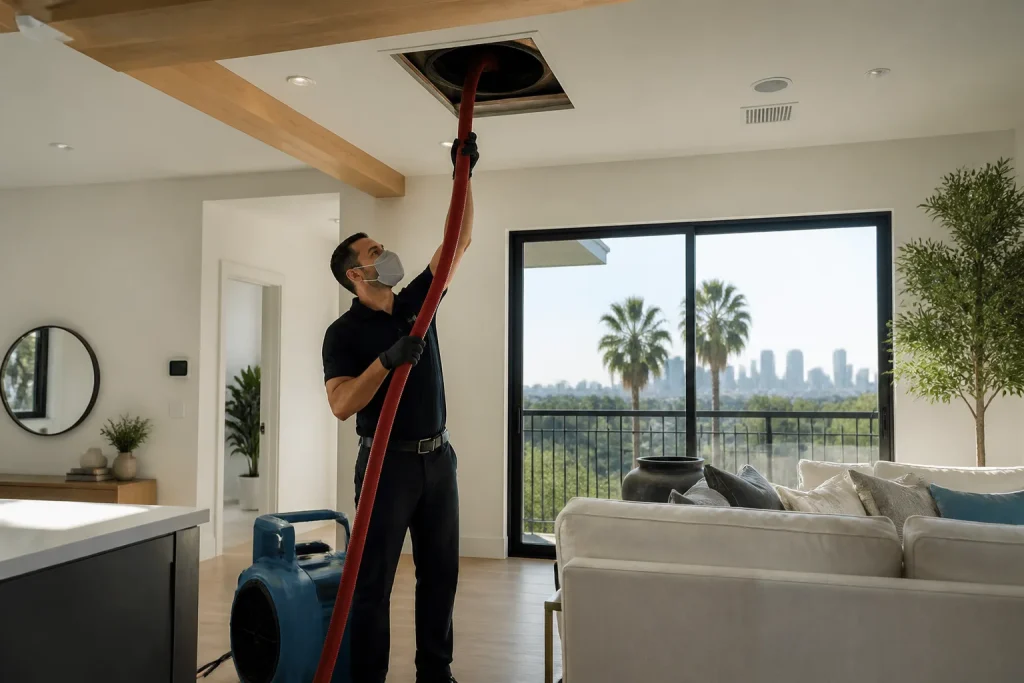
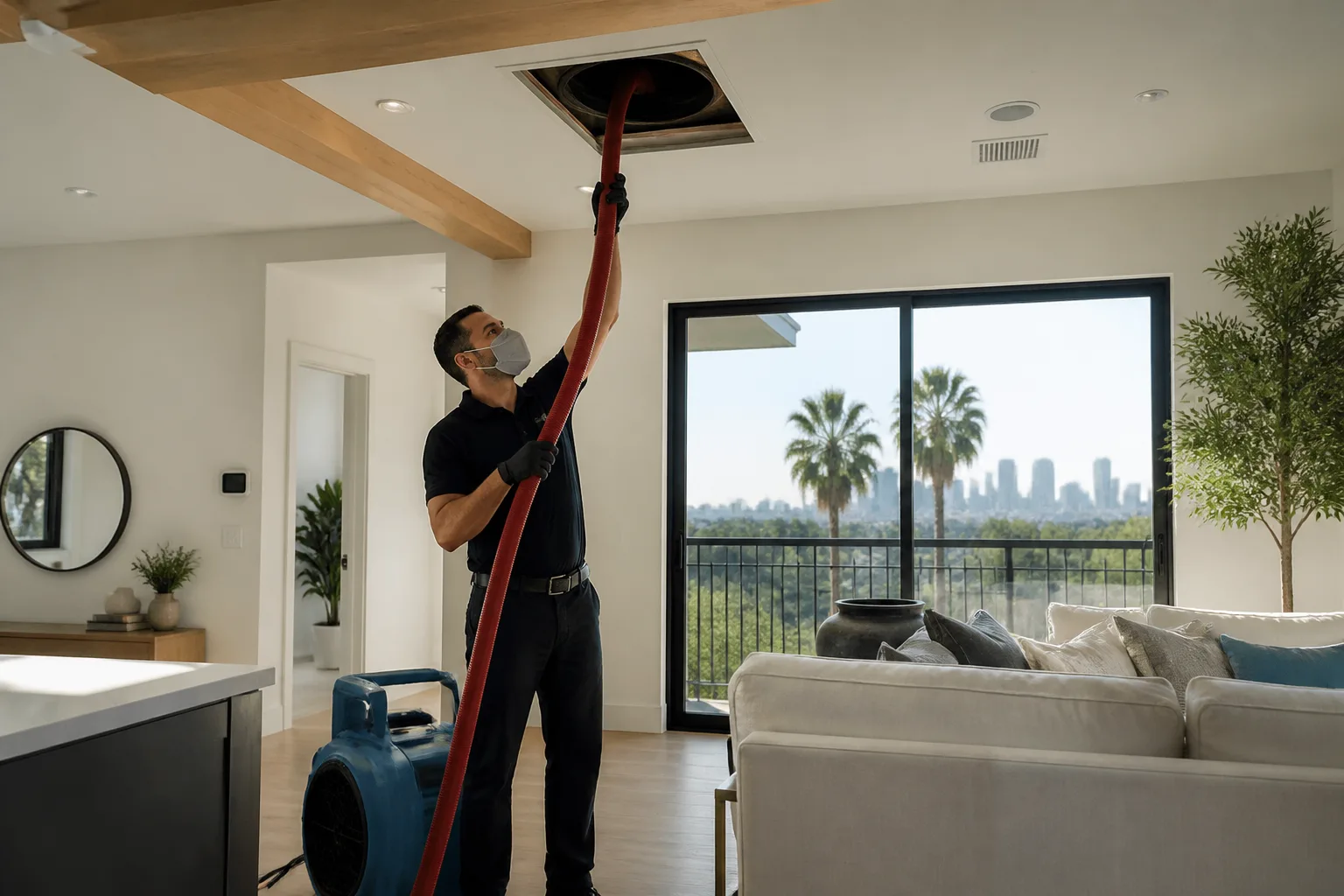
We run into this equipment every week at Kestrel Air Duct Cleaning, usually when a homeowner calls after a fire in the neighborhood or a bathroom leak that sat too long. The homeowner says the ducts feel gritty or smell musty. A standard truck-mounted vacuum won’t touch pores that fine. Negative-air extraction, which means pulling air through the system under pressure so nothing escapes into the living space, is the right tool. We use Abatement Technologies units alongside our Nikro negative-pressure systems and Rotobrush rotary brush systems on jobs like these because the brush dislodges what’s stuck to the duct walls while the HEPA filtration keeps it out of your air.
Standard Duct Cleaning vs. Remediation-Grade Work: What’s the Difference?
The distinction matters because the cost is different, the time on site is different, and the paperwork you should demand is different. Here’s how the two compare for a typical 1,500 to 2,500 square foot Los Angeles home:
| Factor | Standard Duct Cleaning | Remediation-Grade Work |
|---|---|---|
| Primary equipment | Truck-mounted vacuum, rotary brush | Portable negative-air machine with HEPA filtration, containment |
| Typical cost range | $450 – $850 | $1,200 – $3,500 depending on contamination scope |
| Duration | 3 – 6 hours | 1 – 2 days, sometimes longer |
| Documentation | Cleaning receipt | Pre/post air testing, written clearance report |
| When it’s appropriate | Routine dust, pet dander, light debris | Wildfire ash, mold, asbestos, post-construction particulate |
Most Los Angeles homes need the standard option. You change your filters, vacuum the registers, and every three to five years, a thorough cleaning with a brush system and truck-mounted vacuum handles what’s accumulated. But when fine particulate gets inside the ducts themselves, the standard approach won’t clear it. In our experience over near Silver Lake and Echo Park, homes that sit within a mile or two of a wildfire burn zone routinely show a fine gray film inside the ductwork months after the smoke clears. That film is ash and combustion particulate. A truck-mounted vacuum will pull some of it, but the finest fraction stays airborne and resettles. That’s when negative-air equipment becomes the honest recommendation.
Los Angeles Wildfires and What They Leave Inside Your Ducts
Los Angeles gets wildfire smoke almost every year now, and it’s not just an outdoor problem. When the air outside carries fine ash and VOCs from burning structures and vegetation, your HVAC system pulls that air inside. The blower fan forces it through the ductwork, where the finest particles settle into the dust already lining the duct walls. Once the smoke clears, every time your system cycles, a faint smoky smell returns even months later.
That’s not a situation where a basic cleaning cuts it. A remediation-grade approach with a portable HEPA-filtered negative-air unit creates negative pressure inside the duct system while technicians agitate the inner walls with rotary brushes. The loosened particulate gets pulled directly into the HEPA filtration, never into your living room. We’ve done this work in homes from air duct cleaning in Los Angeles neighborhoods across the San Fernando Valley to the Westside. The homeowners usually say the same thing: the smell disappeared after one cycle, and they didn’t realize how much they’d been breathing until it was gone.
If you had a fire anywhere near your home, or if your neighborhood was under an evacuation warning at any point in the last year, it’s worth having the ducts inspected by someone who knows what combustion particulate looks like. It’s gray, it’s fine, and it clings to duct walls in a way regular household dust doesn’t.
What Documentation You Should Demand When Remediation Equipment Is Used
Any contractor using Abatement Technologies-class equipment on your home should be providing documentation that proves the work actually addressed the contamination. If they hand you a standard invoice and call it a day, that’s a red flag. Here’s what you should receive:
- Pre-cleaning air-quality assessment: A baseline measurement of particulate levels, ideally with a particle counter reading before any equipment is switched on.
- Scope-of-work description: A written statement of what was found, what equipment was used, and what areas of the system were addressed.
- Post-cleaning air-quality reading: A second particle count taken after the job, showing the reduction in airborne particulate.
- Written clearance report: A document stating the system has been cleaned to a specified standard and the air quality meets acceptable thresholds.
These documents matter for two reasons. First, they’re how you verify the work was actually done rather than just invoiced. Second, if you ever sell your Los Angeles home, having written clearance documentation from a remediation-grade cleaning can answer buyer questions about indoor air quality. Without paperwork, you paid for a promise. With it, you paid for a verifiable outcome.
How to Verify a Contractor Is Using Abatement Equipment Appropriately
The brand name shouldn’t be doing the selling. A contractor who leads with “we use Abatement Technologies” on a standard $500 duct cleaning is using a credible name to justify a higher price, but the equipment only matters when the job actually calls for it. Here’s how to tell the difference:
- Ask what they’re containing. Negative-air machines are for containment. If the contractor can’t tell you what contaminant they’re containing in your home, the equipment is probably window dressing.
- Ask about pre-testing. A remediation job starts with a particle count or air sample before the machine ever gets plugged in. If there’s no pre-test, there’s no baseline to measure against.
- Ask what the final report will show. You should get numbers, not adjectives. A clearance report that says “cleaned thoroughly” without any measurements is a receipt, not a report.
- Ask about the containment setup. Portable HEPA units on a remediation job typically run with plastic sheeting or other containment around work areas. If there’s no containment and no measurement, you’re paying remediation prices for a standard clean.
We carry Abatement Technologies equipment on hand, but we reach for it when the job calls for it, not because a homeowner asked about the brand name. The same goes for our Rotobrush systems and Nikro negative-pressure units. These are tools, not marketing props. The dryer vent cleaning in Los Angeles side of our work uses the same philosophy: the right tool for the actual problem, with the proof in writing before we leave.
The Bottom Line
“Abatement Technologies air duct cleaning” is not a service category. It’s a clue. When that name appears in a quote for your Los Angeles home, it means someone is planning containment-grade work, and you should be asking for the documentation to match. Standard cleaning ranges from roughly $450 to $850 for most homes. Remediation-grade work runs higher because it involves air testing, HEPA-filtered negative-air extraction, and written clearance, and you should not accept one without the other.
If you’re in Los Angeles and you’re not sure which category your ducts fall into, get an honest assessment from someone who carries both types of equipment and knows when each is called for. Kestrel Air Duct Cleaning offers free estimates, a written price before work begins, and a Done Right Promise on every job. Call (469) 972-3151 and talk to a live person who can help you figure out what you’re actually dealing with.
Frequently Asked Questions
No. Abatement Technologies manufactures containment equipment, negative-air machines, and HEPA air scrubbers used by remediation contractors. The company doesn’t clean ducts. If a contractor mentions the brand, they’re telling you what equipment they use, not what company they work for. In Los Angeles, the name tends to come up on jobs involving wildfire ash, mold, or post-construction particulate. For a standard dust-and-dander cleaning, the equipment is unnecessary, and any contractor suggesting otherwise should explain what exactly needs containing. Call (469) 972-3151 if you want someone to assess which situation you have.
Most homes with genuine contamination issues run between $1,200 and $3,500 for remediation-grade duct work, depending on the size of the system and the scope of the contamination. Standard cleaning by comparison runs $450 to $850. The price difference buys you HEPA-filtered negative-air extraction, containment setup, before-and-after air testing, and written clearance documentation. If a quote includes “Abatement Technologies equipment” but costs $600 and includes no testing, you’re paying for a standard cleaning with a marketing upgrade. Call (469) 972-3151 for an honest quote on whichever one applies to your home.
Cheaper quotes usually mean a truck-mounted vacuum, no air testing, no containment, and no written clearance report. For homes with routine dust, that’s often fine. For homes with wildfire ash, mold, or smoke residue, a cheap cleaning will leave the finest particulate in the air, and it settles right back into the ducts within weeks. Kestrel gives one flat price per system before work starts, with the equipment and documentation matched to the actual condition of your ducts. Call (469) 972-3151 and we’ll tell you which level of cleaning your home actually needs.
You should receive before-and-after air-quality readings and a written clearance report when remediation-grade equipment is used. Standard cleanings should come with a written description of what was cleaned and what was found. If a contractor can’t show you what changed, you paid for trust, not outcomes. At Kestrel, every job includes written documentation, and our Done Right Promise means if the work falls short within the guarantee period, we come back and make it right at no charge. Call (469) 972-3151 for a free estimate.
Written by the team at Kestrel Air Duct Cleaning.
Need Air Duct Cleaning Help?
Call Kestrel Air Duct Cleaning - licensed & insured, here with fast after-hours help in Los Angeles.
(469) 972-3151