
Dryer Vent Cleaning: Repair or Replace? How Los Angeles Homeowners Decide
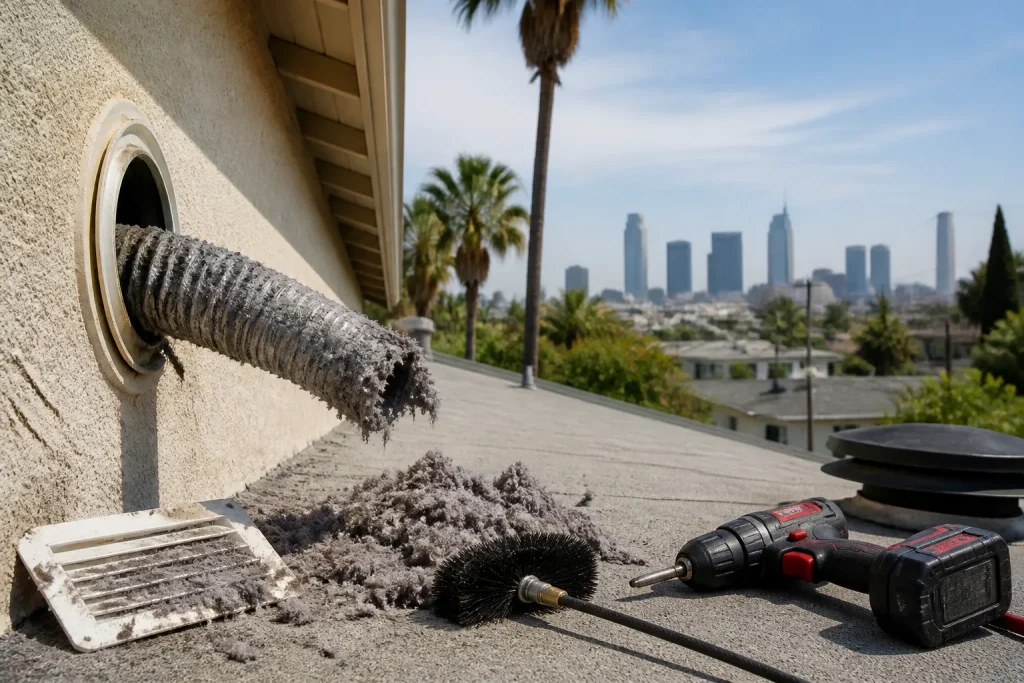
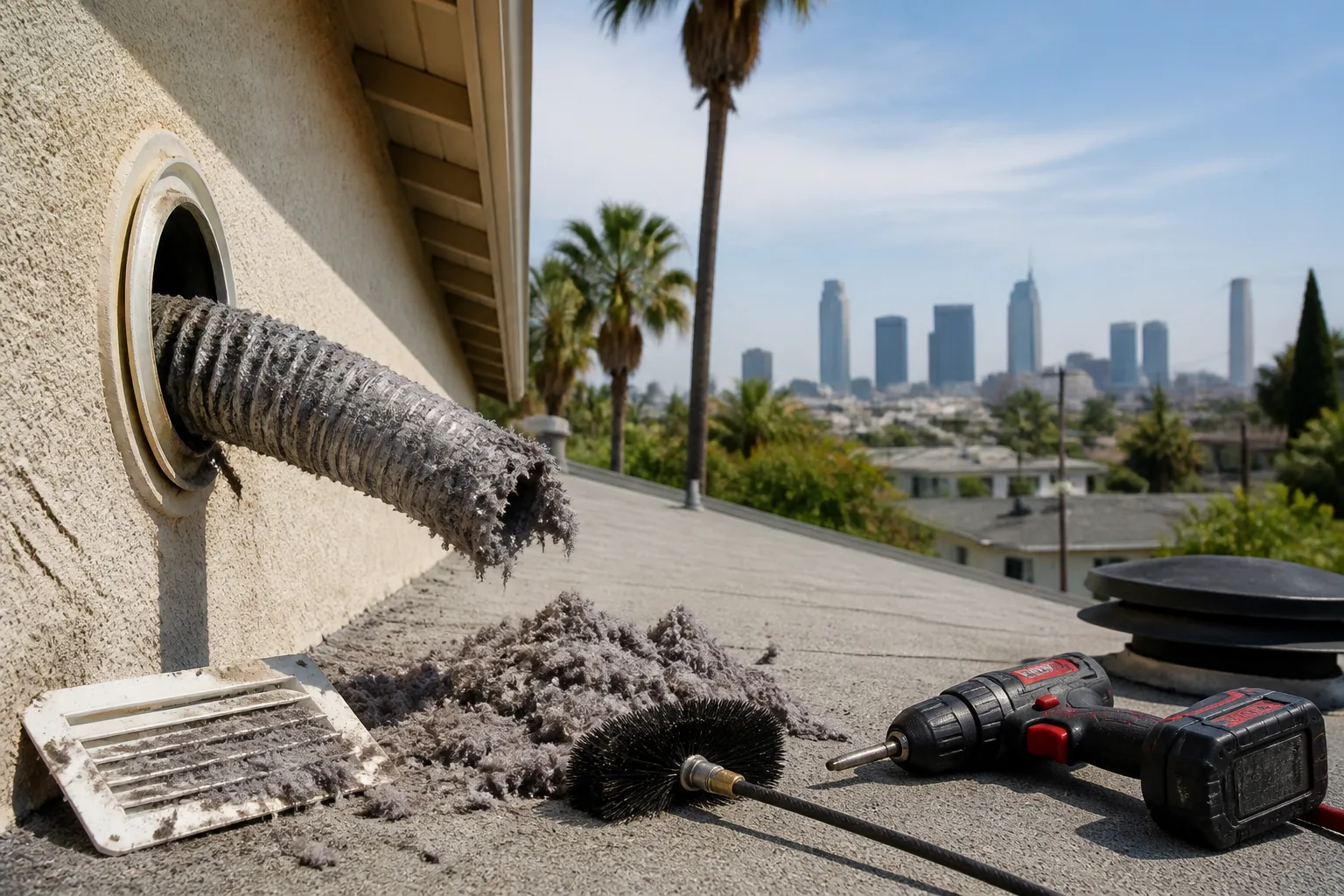
Most dryer vents in Los Angeles don’t need replacing. They need a real cleaning, done with negative-air extraction that pulls lint out instead of pushing it around. But maybe one in five vents we inspect has a structural problem that cleaning won’t fix, and paying to clean a crushed duct is throwing money away. Here’s how to tell the difference before you spend a dollar.
Why “Cleaned Recently” Doesn’t Mean Safe
The Los Angeles Fire Department logs hundreds of dryer-related structure fires every year. Plenty of those homes had the vent cleaned within the previous twelve months. That’s the part nobody talks about. A vent can be spotless inside and still be a fire hazard, because the problem was never the lint. The problem is the duct itself.
We see this constantly in LA. Someone pays a company to run a brush through the line. Six weeks later the dryer is taking two cycles to dry towels again. The homeowner assumes the cleaners did a bad job. Sometimes that’s true. But just as often, the duct is crushed behind the wall, or the joints have separated, or the original builder used foil flex and twenty years of thermal cycling turned it into an accordion. You can clean that duct every month and it will still trap lint at the same choke points. The cleaning isn’t failing. The duct has failed.
The Three Physical Signs a Vent Can’t Just Be Cleaned
Before anyone quotes you a cleaning price, look at the vent with a critical eye. We’ve put together the three signs that tell us, from experience, that cleaning alone won’t do it.
- Crushed flex duct. If any section visible in the garage, attic, or crawlspace looks flattened or kinked, lint is piling up at that bend no matter how well the rest of the line is cleaned. In Los Angeles, foil flex is the default in tens of thousands of pre-2000 homes, and foil flex crushes. Every time someone shoves a storage bin against the dryer, every time a rat or a raccoon walks across it in the attic, the cross-section shrinks.
- Disconnected joints. Duct sections are supposed to be joined with metal tape or clamps, not duct tape. Duct tape dries out and fails in LA’s summer heat. When a joint separates, the dryer is blowing hot, damp, lint-filled air into the wall cavity or the attic, not outside. Cleaning that line doesn’t fix a joint that isn’t connected. The air never reaches the termination point.
- Melted plastic end caps. If the louvered cap on the outside wall is plastic and looks warped or melted, that’s a sign the vent is running hotter than it should. Plastic caps on a dryer vent were never a good idea, and once they warp they no longer open and close properly. It’s a cheap fix, but it’s a replacement, not a cleaning.
If you see any one of those three, don’t book a cleaning. Book an inspection with a company that will tell you the truth and put a price in writing before touching anything.
How LA’s Building Eras Dictate the Repair-or-Replace Call
Los Angeles is not one housing market. It’s five or six, stacked on top of each other by decade. And each era of construction has its own characteristic dryer-vent problem. Knowing which one applies to your house tells you, with maybe 80 percent confidence, whether you’re a clean-and-go or a replace-and-redo.
Pre-1978 slab homes. In much of the Valley, South LA, and the older parts of the Westside, the dryer vent was an afterthought. Builders ran a short piece of flex through the nearest exterior wall, often less than six feet, because the laundry was in a garage or a utility room on the outside wall. Short runs are good, but the materials are old and usually foil flex. These are the homes where we most often find a collapsed duct crushed inside the wall and the homeowner has no idea. The wall is the vent, for all practical purposes.
1980s – 90s stucco condos and townhomes. This is the era that gives us the most repair work. Laundry rooms moved to interior spaces, which means the vent has to travel further, often up through an attic or across a chase to reach an exterior wall. Builders used foil flex for the entire run because it was fast and cheap. Twenty or thirty years later, that flex has sagged between supports, filled with low spots, and was likely chewed by rodents at some point. In our experience, maybe half of the vents in this era are in good enough shape to clean. The other half need a section replaced or the entire run swapped to rigid metal.
Post-2000 townhomes and single-family builds. Code changed. Newer construction in Los Angeles generally uses rigid galvanized metal duct with smooth interiors and mechanical joints. These vents almost never need replacement. They collect lint like any duct, but the walls are smooth and the joints hold. If you’re in a home built after 2000, figure on cleaning every year or two and probably never replacing, unless a specific section got damaged by a remodel.
The Case for Rigid Duct: What Replacement Actually Costs
When a vent can’t be cleaned, the fix in most Los Angeles homes is to replace the failed section, or the entire run, with rigid galvanized metal. We tell people to think of this as a materials decision, not a luxury upgrade. The metal itself is cheap. The labor is where the cost sits, because the technician has to get at the duct, which sometimes means removing a section of drywall or working in a hot attic.
For a typical LA home, replacing a failing flex run with rigid metal runs between $150 and $400, depending on length, accessibility, and whether the existing penetration through the wall can be reused. That’s for a straightforward swap. If the vent path is buried in finished walls with no attic access above it, the price goes up because there’s drywall work involved.
Compare that to paying $120 to $180 for a cleaning every year on a duct that’s crushing itself. The cleaning buys you a temporary improvement. The replacement buys you a vent that stays clear for a decade and passes an inspection when you sell. It’s not close. If the duct is structurally compromised, replacement is the cheaper option over any five-year window.
The Los Angeles Permit Question
Here’s what most people don’t know and most contractors won’t volunteer: some dryer-vent replacements in the City of Los Angeles require a permit, and some don’t. The dividing line is whether the work involves modifying the structure or just swapping materials in the same path.
If you’re replacing a flexible duct with rigid metal through the existing penetration, same route, same wall cap location, that’s a materials swap. It generally doesn’t require a permit. If the work involves cutting a new penetration through an exterior wall, moving the termination point, or rerouting the duct through framing, that’s a modification, and the LA Department of Building and Safety wants to see a permit for it. A licensed contractor doing work in your wall should be able to tell you which situation you’re in without hesitating, and should be willing to say so in writing.
The other wrinkle is resale. If a previous owner, or a handyman, moved the dryer vent without pulling a permit and the modification wasn’t done to code, that can surface in a home inspection when you sell. The fix at that point is more expensive than doing it right the first time, because you’re also paying to make the old mistake right before you can bring the new work up to standard. We’ve had calls from sellers a week before close because an inspector flagged a vent terminated into an attic or a wall cavity. That’s not a “we’ll get to it later” problem. That’s a fire hazard the buyer’s lender may insist on fixing before funds move.
What a Written Price for Either Job Should Look Like
Here’s the test we suggest to every Los Angeles homeowner, whether you call us or someone else. Ask for the price in writing, before the work begins, with the line items separated. Not a single number scrawled on the back of a quote sheet. Line items.
A written quote for dryer-vent cleaning should show the base service fee, the number of vents covered, any charge for an exterior wall cap cleaning or replacement, and any diagnostic charge that gets waived if the work proceeds. A replacement quote should show the duct material, the estimated labor, the liner feet, any drywall or stucco repair allowance, and a separate line for the permit if one’s required. If a contractor won’t itemize what they’re going to do before they open the wall, don’t let them open the wall. It’s that simple.
Our pricing works differently. The written price is in your hands before a single vent is touched. No door-step revisions, no “we found something while we were in there” negotiation. That’s not a promotional offer. It’s a standing commitment that has been part of every job since the company was founded under the Kingswell Guarantee. The same written standard applies to every visit, and the Done Right Promise covers the work in writing. If the vent falls short within that year, we come back and make it right at no charge.
When to Call a Pro (and When to Wait)
If you can see the entire vent run from the dryer to the outside wall, and it’s a short, straight piece of rigid metal, you can keep an eye on it yourself. Pull the dryer out once a year, disconnect the line, and look inside with a flashlight. If it looks like the inside of a dryer sheet, call a professional. If it’s a light dusting and the air still moves, you’ve got time.
The rest of the time, the vent is hidden. It’s in a wall, an attic, or a crawlspace, and the only visible evidence of a problem is a dryer that suddenly needs ninety minutes to dry a load that used to take forty. That’s the moment to call. A vent that’s working correctly moves air fast enough that you’ll hear the air moving at the exterior termination, and the laundry room will not feel humid after a cycle. If your laundry room feels like a sauna and the exterior vent barely moves, the duct is fighting you. Don’t ignore it. Lint is the fuel, and a dryer is a heat source, and a clogged vent is the box they both sit inside. The only thing left is the spark.
Related services in Los Angeles: Dryer Vent Cleaning in Los Angeles and Air Duct Cleaning in Los Angeles.
The Bottom Line
Most of the time, a dryer vent that’s acting up in Los Angeles needs cleaning, not replacement. But a vent that’s crushed, disconnected, or melted at the termination point needs repair or replacement first, and cleaning it without fixing the structure is wasted money. The house’s construction era tells you a lot before anyone even looks at the vent. Pre-1978 slab homes and 1980s – 90s stucco condos are far more likely to have failing foil flex than anything built after 2000. Replacing that flex with rigid galvanized metal costs $150 to $400 in most LA homes and will outlast three cleanings. Get every price in writing, itemized, before the work begins. If you’re in Los Angeles and need help sorting out which category your vent falls into, Kestrel Air Duct Cleaning offers free estimates. Call (469) 972-3151 and we’ll walk you through it.
Frequently Asked Questions
Most homes in Los Angeles run between $120 and $180 for a thorough dryer vent cleaning with negative-air extraction, which pulls lint out of the duct instead of just brushing it loose. If the vent is especially long or hasn’t been cleaned in years, the price can run a bit higher. Call (469) 972-3151 for an exact quote in writing before any work begins.
A vent that’s dirty but intact needs cleaning. A vent that’s crushed, has separated joints, or has a melted plastic end cap needs repair or replacement before cleaning means anything. If your dryer is taking two cycles to dry clothes and the exterior vent feels weak, have a professional inspect the line before booking a cleaning.
Replacing a failing flex duct with rigid galvanized metal in most Los Angeles homes costs between $150 and $400, depending on the length of the run and how hard it is to access. If the replacement requires opening finished walls or pulling a permit for a new exterior penetration, the price goes up.
Swapping existing duct materials through the same route and exterior penetration generally doesn’t require a permit. Cutting a new hole through an exterior wall, moving the termination point, or rerouting the duct through framing does. A contractor doing the work should tell you which applies to your job and put it in writing.
Cheaper quotes often come from crews that run a brush through the line and don’t fix the things that are actually causing the clog. Some skip the exterior wall cap, some don’t use negative-pressure equipment that keeps loosened lint out of the living space, and some quote a low per-vent price that mushrooms once the van is in the driveway. A written, line-item quote before work starts protects you from all of it.
Written by the team at Kestrel Air Duct Cleaning.
Need Air Duct Cleaning Help?
Call Kestrel Air Duct Cleaning - licensed & insured, here with fast after-hours help in Los Angeles.
(469) 972-3151