
5 Mistakes to Avoid With Air Duct Cleaning
The five costliest air duct cleaning mistakes happen after you hire a legitimate company, not before. They’re the decisions homeowners make the day of the job: running the fan wrong, leaving an old filter in place, or not confirming exactly what the written scope covers. Avoid these five and you’ll actually get the clean air you paid for. And if you’d rather not think about any of it, call (469) 972-3151 and we’ll walk you through the whole thing.
We’ve been cleaning ducts in Los Angeles, and here’s what we know: hiring a reputable, licensed duct cleaner and still ending up with worse indoor air three weeks later is more common than you’d think. It almost always traces back to one thing the homeowner did or didn’t do on the day of the job. The contractor did decent work. The system was cleaned. Then something quietly undid it.
So this isn’t another “watch out for scams” list. You already know about the $79 coupon that becomes $900 at the door. The mistakes below are the ones we see honest homeowners make after they’ve already picked a good company. Fix these and the job actually sticks.
Mistake 1: Running the HVAC Fan on “Continuous” Before the Crew Arrives
Here’s a scenario we see in Los Angeles homes all the time. The homeowner wants to be helpful, so the night before the appointment, they switch the thermostat fan from “auto” to “on” to “circulate some air through the system.” They figure it’ll loosen things up, give the technicians a head start.
What actually happens: the fan pulls air across duct walls that haven’t been cleaned yet, lifts loose debris sitting in the return plenum, and redistributes it through every supply register in the house. Rooms that were perfectly fine the day before now have a fresh dusting of the exact particulate the cleaning was supposed to remove. The technicians arrive to a worse starting point than they would have had otherwise.
The fix is simple. Leave the thermostat fan on “auto” before the appointment. Let it cycle naturally, or turn the system off entirely. Let the crew be the first thing to disturb that dust, because when they do, they’re doing it with a negative-pressure unit pulling it out of the house rather than a fan pushing it into your bedrooms.
Mistake 2: Not Replacing the Filter Immediately After the Job
A freshly cleaned duct system with a clogged, six-month-old filter is a two-day countdown to disappointment. We’ve watched it happen often enough that it’s now the first thing I check when a Los Angeles homeowner calls us back after a job.
Here’s the sequence. The ducts are clean. The blower cabinet is clean. Dust counts in the living space dropped right after the cleaning. Then normal operation resumes, and every ounce of air the system pulls passes through a filter so loaded that it’s either bypassing around the edges or shedding trapped particles back into the airstream. Within 48 hours, fine particulate is being re-deposited into the rooms you just cleared. The ducts didn’t get dirty again. The filter reintroduced the dirt.
Replace the filter the day the ducts are cleaned. Not “soon.” The day.
And while we’re on the subject: filtration quality matters more than most people realize. We regularly recommend Honeywell and Guardsman filters to customers who want something better than the basic spun-fiber option from the hardware store. A pleated filter with a decent MERV rating traps the fine stuff that settles inside ducts in the first place. If your old filter is caked with visible dust, a good replacement is the difference between a duct cleaning that holds for years and one that fades in weeks.
Mistake 3: Scheduling During Active Drywall or Flooring Work
If a contractor is still sanding drywall, cutting tile, or refinishing floors in your Los Angeles home, do not schedule duct cleaning that same week. This one costs people real money, and we try to catch it before the appointment is even booked.
Construction dust is not like household dust. Household dust is mostly skin cells, fabric fibers, and pet dander. Construction dust is silica, gypsum, and sanded hardwood, all of it fine enough to stay airborne for hours and slip through whatever plastic sheeting the contractor hung. When your HVAC system pulls return air during active work, it ingests this dust directly into ducts that were, a day ago, spotless. It re-coats every surface with alarming speed, often within 72 to 96 hours.
The order of operations matters. Finish the construction work first. Have the site cleaned thoroughly. Then, and only then, clean the ducts. Do it in reverse and you’ve bought the same job twice.
Dale, our owner, has a standing rule for his own home projects: ducts are the very last trade in, always. He’s seen too many jobs in places like Mid-City and Sherman Oaks where a homeowner cleaned the ducts during a kitchen remodel and called six weeks later wondering why the registers were already filmed with dust again.
Mistake 4: Assuming “All Ducts” Means All the Ducts
“The ducts” is a phrase that means different things to different people, and the gap between those definitions is where homeowner disappointment lives. This is the most preventable mistake on this entire list, and it takes about four minutes to fix.
- The supply ducts carry conditioned air from the furnace to the rooms.
- The return ducts pull air back from the house to the system.
- The return-air plenum is the large box where return air gathers before entering the blower.
- The dryer vent is an entirely separate duct that runs from the dryer to the outdoors.
- The bath exhaust fan duct is yet another separate run.
Many homeowners assume all of it is included in one “whole-system cleaning.” It’s a reasonable assumption. It is also, frequently, wrong. Some companies scope the main trunk lines and supply runs only, leaving the return plenum untouched. Others exclude the dryer vent because it’s technically a different system. Bath exhausts are routinely skipped.
Get it in writing before the job starts. Confirm that the scope includes the return side, the plenum, and any branch runs. If the dryer vent needs cleaning, say so and get it on the same written estimate. The written scope is what protects you. The handwritten margin note you think the technician made? It doesn’t exist if it’s not on the document.
Under our Kingswell Guarantee, the price is in writing before a single vent is touched. That document also says exactly what is and isn’t included. If a customer asks us to add the Dryer Vent Cleaning in Los Angeles to their duct job, we add it to the written estimate before work starts, not as a surprise invoice at the end. That’s the way it should work everywhere.
Mistake 5: Ignoring Post-Cleaning Airflow Checks
Once the ducts are clean, most homeowners close the book. The crew packs up, the invoice gets paid, and everyone moves on. That’s when a subtle, pre-existing problem can quietly resurface.
A duct that was partially collapsed or restricted before cleaning now has less resistance. Clean ducts move more air. When system pressure changes, a marginally closed register damper that was never noticed can now flutter, whistle, or shut off airflow to a room altogether. The cleaning didn’t cause the problem; it revealed it. But if nobody checks airflow after the job, the homeowner notices a stuffy bedroom three nights later and blames the cleaning company.
Here’s the simple version: before the technicians leave, walk the house with them. Feel the airflow at each register. Note any room that feels weaker than the others. Ask whether any registers were closed or partially closed during the cleaning. A register damper is a small adjustment, but finding it after the crew has driven away usually means someone has to come back, and nobody enjoys scheduling a callback for a damper.
When we finish a job, our technicians do a room-by-room airflow pass as part of the walkthrough. It takes ten minutes. It catches this exact issue more often than homeowners might expect, especially in older Los Angeles homes with original sheet-metal ductwork and decades-old dampers.
When to Call a Pro Rather Than Managing It Yourself
There’s a line between homeowner diligence and trying to run the job yourself, and stepping over it doesn’t help anyone. If you find yourself vacuuming register openings before the crew arrives, or removing vent covers to pre-clean them, or mapping the duct layout by flashlight, it’s time to step back.
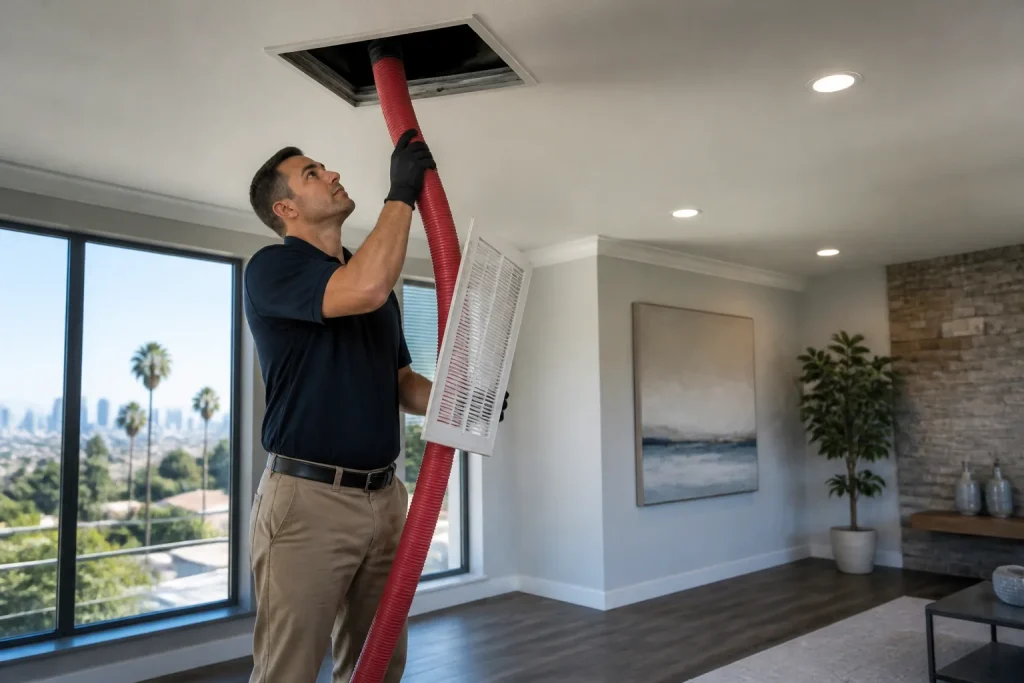
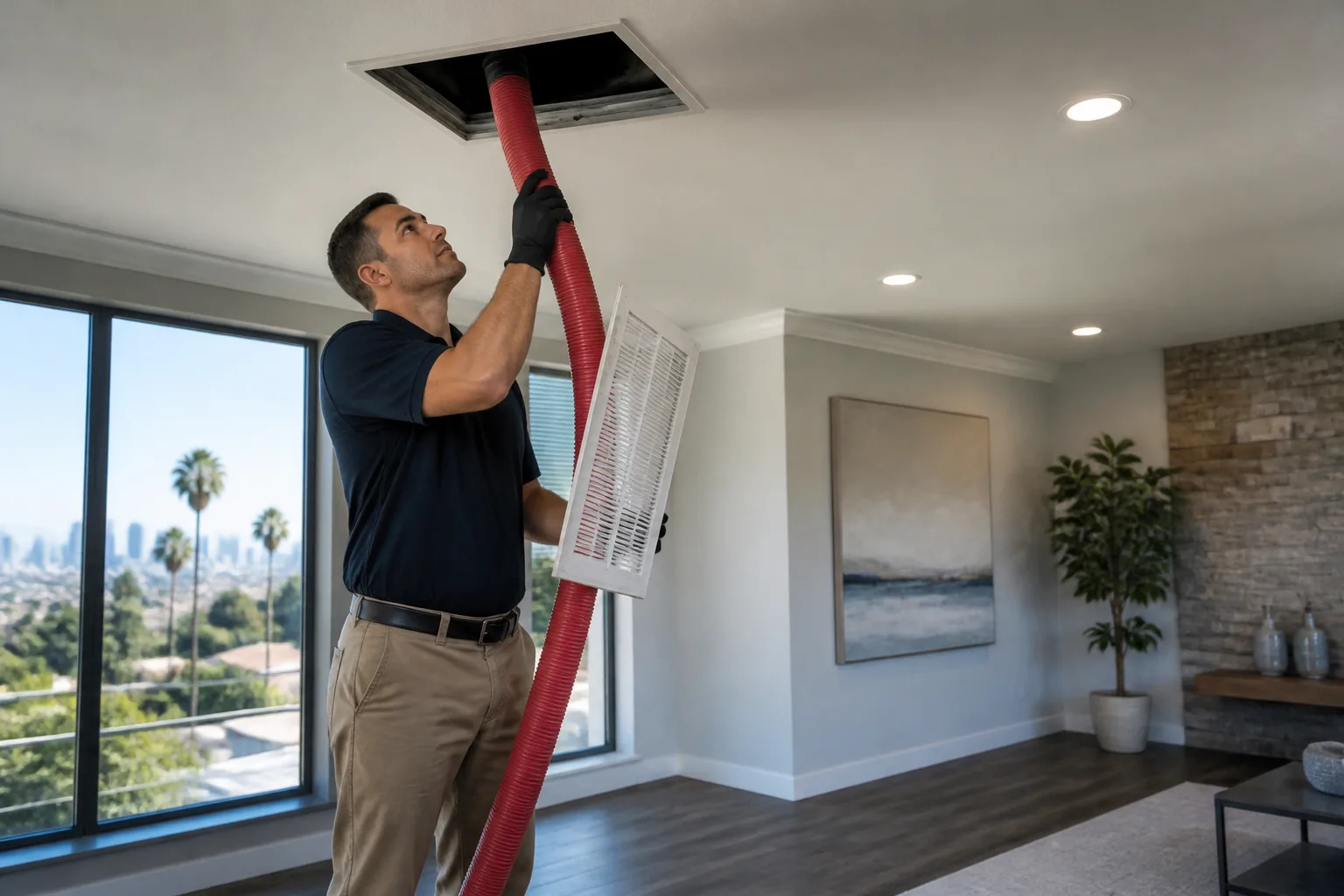
A reputable company uses professional-grade equipment for a reason. The Rotobrush rotary brush system agitates debris off the duct walls. Nikro negative-air units pull dislodged contaminants out of the system under vacuum so they don’t escape into the living space. Abatement Technologies HEPA filtration traps fine particles during the job. That’s what you’re paying for. None of it requires homeowner preparation beyond what’s described above: fan on auto, filter ready, construction finished, scope in writing.
If any of this feels like more than you want to manage, that’s completely fine. Most people hire us exactly because they don’t want to think about return plenums and register dampers. The only real precondition to a good job on the customer’s side is a written scope and a clean filter ready to go in when we’re done.
The Bottom Line
Five mistakes. Five simple fixes. Keep the fan on auto before the crew arrives. Swap the filter the day the cleaning is done. Wait until construction work is finished and cleaned up. Confirm the written scope covers the return plenum and dryer vent. And do a ten-minute airflow walkthrough before the technicians leave.
None of these require special tools or training. They require attentiveness, and that’s the part nobody can outsource. The best duct cleaning company in Los Angeles can’t stop you from running the fan on continuous the night before, and a filter you never replaced will undo their work within days.
If you’re in Los Angeles and want the job done honestly, with a written price before work starts and a Done Right Promise in writing on every single job, give us a call. We’ll walk you through the process, answer every question on this list, and leave you with ducts that stay clean. Call (469) 972-3151 for a free estimate, or visit the Kestrel Air Duct Cleaning home page to see how we work.
Frequently Asked Questions
Check the return-air registers. If visible dust is built up on the louvers only weeks after you last wiped them down, or if you see dust puffs from the supply registers when the system kicks on, the ducts are likely carrying a load worth cleaning. Other signals include persistent dust accumulation on furniture despite regular cleaning, worsening allergy symptoms at home, or a musty odor when the HVAC runs. In Los Angeles, with the dry climate and the way windows stay open year-round, dust loads accumulate faster than homeowners expect.
For a typical 2,000 to 2,500 square-foot Los Angeles home, expect the job to run between 3 and 5 hours. The work includes setting up negative-air extraction equipment at the furnace, agitating each run with a rotary brush, cleaning the return plenum, and walking through the house to confirm airflow at every register. Homes with more complex duct layouts or a separate return on each floor may take longer. A same-day completion is standard for a single-family residence.
It can, but not because of the cleaning itself alone. The benefit comes from the filter replacement and undoing the airflow restrictions that dirty coils, blowers, and dampers create. A system moving air through clean ducts with a fresh filter doesn’t work as hard to hit the thermostat setpoint. In Los Angeles, where air conditioning runs for months at a stretch, that lower strain translates to modest but real savings over time. The bigger payoff is system longevity and indoor air quality.
Ask for before-and-after photos of the interior of the ducts. Any reputable company can show these, because the equipment used to do the work includes cameras and inspection tools. You should also walk the house during the final airflow check and look for visible residue removal at each register. And above all else: the scope of work should be on paper before the job starts, with the completed work initialed and confirmed after. At Air Duct Cleaning in Los Angeles through Kestrel, that written record is part of every single job under the Kingswell Guarantee. If the work falls short within 365 days, we come back and make it right at no charge.
Written by the team at Kestrel Air Duct Cleaning.
Need Air Duct Cleaning Help?
Call Kestrel Air Duct Cleaning - licensed & insured, here with fast after-hours help in Los Angeles.
(469) 972-3151