
Nikro Air Duct Cleaning in Los Angeles: A Homeowner’s Guide
Nikro negative-air equipment is the difference between a duct cleaning that removes surface dust and one that actually extracts the debris packed inside trunk lines. For Los Angeles homes with large central systems, this matters more than most contractors will admit. Here’s what Nikro equipment actually does, when it’s the right tool, and how to make sure you’re not paying for a big machine that’s doing small work. If you’d rather skip the research and talk to someone who runs this equipment daily, call (469) 972-3151.
What Nikro Negative-Air Extraction Actually Means
Most residential duct cleaners in Los Angeles show up with a portable vacuum and a flex rod. Nikro negative-air units pull 4,000 to 6,000 CFM, roughly 15 times the suction of a shop vac, and for homes with large central duct systems, that difference is not marketing. It’s physics.
Here’s the plain-English version. Negative-air extraction means the Nikro unit connects to the duct system and pulls air out of it continuously, creating a pressure differential inside the ductwork. The air outside the ducts is at normal atmospheric pressure. The air inside the ducts drops below that. That imbalance creates a sustained draw that moves loosened debris toward the collection point rather than relying on mechanical contact alone to scrape it loose.
Think of it like opening a window on a windy day. The air doesn’t need to be pushed through the house. The pressure difference does the work. A Nikro unit creates that pressure difference on a scale that portable vacuums simply can’t match. The unit sits outside or in the garage, connected by a large-diameter hose to the main trunk line. As technicians agitate debris inside the ducts, the negative pressure pulls it downstream into a collection bag or HEPA-filtered containment unit.
In Los Angeles, where many homes have duct runs longer than the average house in other cities, that sustained draw matters. A portable vacuum loses suction quickly as distance from the access point increases. A Nikro unit maintains it. That’s the whole point.
Which Los Angeles Homes Actually Warrant Nikro-Class Equipment
Not every home needs Nikro-class equipment. If a contractor tells you every job requires it, that’s a sales pitch. Here’s where it genuinely fits.
Homes with 3,000 square feet or more of conditioned space. Larger homes mean longer duct runs, more trunk line, and more branch lines. The volume of air inside the system is simply bigger. A Nikro unit’s CFM rating matters because it can move enough air to create meaningful negative pressure across the entire system, not just the first 20 feet of duct.
Commercial-residential hybrids. Los Angeles has plenty of properties that blur the line: a large home with a studio ADU, a duplex with a shared HVAC system, a renovated bungalow with a commercial-grade retrofit. These systems often have oversized trunk lines that hold more debris and require more pull.
Large trunk-and-branch systems. The classic Southern California layout, a big central trunk running through the attic or crawlspace with branches feeding each room. Debris settles in the trunk line because air velocity drops there. A Nikro unit’s sustained negative pressure is designed exactly for this.
Post-construction cleanouts. Renovations in Los Angeles leave drywall dust, sawdust, and debris inside open ductwork. This fine particulate is light enough to stay suspended, but it’s everywhere. Negative-air extraction pulls it out in a way that mechanical brushing alone cannot, because the brush only touches the surfaces it reaches. The airflow reaches everywhere.
For a standard 1,200- to 1,800-square-foot home with short duct runs, a well-run Rotobrush system with a capable vacuum is usually sufficient. The equipment matters less than the technique. But when the system scales up, the tool has to scale with it.
What Nikro Equipment Does Not Solve
Big CFM ratings sound impressive, and some contractors use them to justify high prices. But there are things a Nikro unit cannot fix, and knowing this will help you ask better questions.
Flex duct debris in branch lines. Nikro negative-air units excel at trunk lines, the large central ducts that move air through the system. But the smaller flex ducts that branch off to individual rooms are often too narrow and too far from the main access point for negative pressure alone to clean thoroughly. These require direct-contact brush agitation. A proper cleaning uses both: the brush works the branch lines loose, and the negative pressure pulls everything downstream and out.
Duct leakage. If your ducts have holes, separated joints, or poorly sealed connections, a Nikro unit will pull air from your attic or crawlspace instead of from inside the ducts. That means less cleaning power where you actually want it, and it means the machine is drawing unfiltered air through the system. Leakage needs to be identified and sealed separately. No vacuum fixes it.
Insulation breakdown inside ducts. Older Los Angeles homes sometimes have internal duct liner that degrades over time. If the liner is flaking or disintegrating, no amount of negative pressure will restore it. The correct fix is duct replacement or re-lining, not cleaning. A reputable technician should tell you this rather than sell you a cleaning that won’t solve the problem.
The Bigger Machine Myth: Why CFM Alone Isn’t Enough
Here’s the misconception worth unpacking: bigger machine, better result. It sounds logical. It’s incomplete.
We’ve seen homeowners in Los Angeles pay a premium for Nikro-class equipment and end up with ducts no cleaner than a careful technician with a Rotobrush system would have delivered. The reason comes down to technique.
Access-point placement matters as much as CFM rating. A Nikro unit can only pull air through the access points the technician creates. If access is only at the return plenum, the negative pressure mostly affects the return side of the system. The supply trunk lines, which often carry more debris in Los Angeles homes because of how returns are configured, get minimal draw. A proper Nikro-based cleaning requires access points cut or opened at strategic locations throughout the system so that airflow is directed through every section.
System isolation is critical. Negative pressure works when it’s directed. If the technician doesn’t seal off registers in rooms not currently being cleaned, or doesn’t isolate one trunk line from another, the airflow takes the path of least resistance. The Nikro unit still pulls 5,000 CFM, but that air is coming from the nearest unsealed opening, not from the debris-laden section at the end of the line. The machine works hard. The ducts don’t get clean.
So when you’re evaluating a Los Angeles contractor who runs Nikro equipment, ask about their process, not just their machine. The equipment matters. The person running it matters more.
What to Look for During a Nikro-Based Duct Cleaning
If you’re paying for professional-grade negative-air extraction, you should see the proof that it’s working. Here’s what a homeowner can reasonably ask to see during the job.
Pressure gauge readings. A properly configured negative-air setup should show measurable negative pressure in the duct system. The technician should be able to point to the gauge and explain what it’s telling them. If there’s no gauge or the reading is flat, the system isn’t pulling as designed.
The collection bag before and after. A Nikro unit captures debris in a collection bag or canister. You should be able to see what came out of your ducts. The bag shouldn’t just look dusty. In a system that genuinely needed cleaning, you’ll see everything from construction debris to the occasional surprise. We pulled a full kid’s soccer sock and half a roll of masking tape out of a trunk line in Encino. The homeowner had no idea. The bag told the story.
A camera pass confirming clean trunk lines. After the cleaning, a camera inspection should show trunk lines with visible metal or duct board surfaces, not a remaining film of dust. This is the confirmation that separates thorough from superficial. If the contractor doesn’t offer camera verification, ask why.
How a Typical Los Angeles Nikro Cleaning Actually Goes
Here’s the sequence so you know what to expect, and what’s reasonable to ask for.
- Walkthrough and system assessment. The technician maps your duct layout, identifies access points, and checks the air handler. This is where they should determine whether Nikro-class equipment is actually the right tool for your home, not the other way around.
- Access point creation. In many Los Angeles homes, existing access is limited to the air handler cabinet. A proper cleaning often requires cutting additional access into trunk lines. The technician should explain where they’re cutting and how they’ll seal it afterward.
- Registers sealed and system isolated. The technician blocks off registers in sections to direct airflow through the system systematically. This is the step that separates competent work from a machine running on full power with nothing to show for it.
- Negative-air unit connected and running. The Nikro unit is connected to the main trunk, often at the air handler or a dedicated access point. The technician should confirm negative pressure before starting agitation.
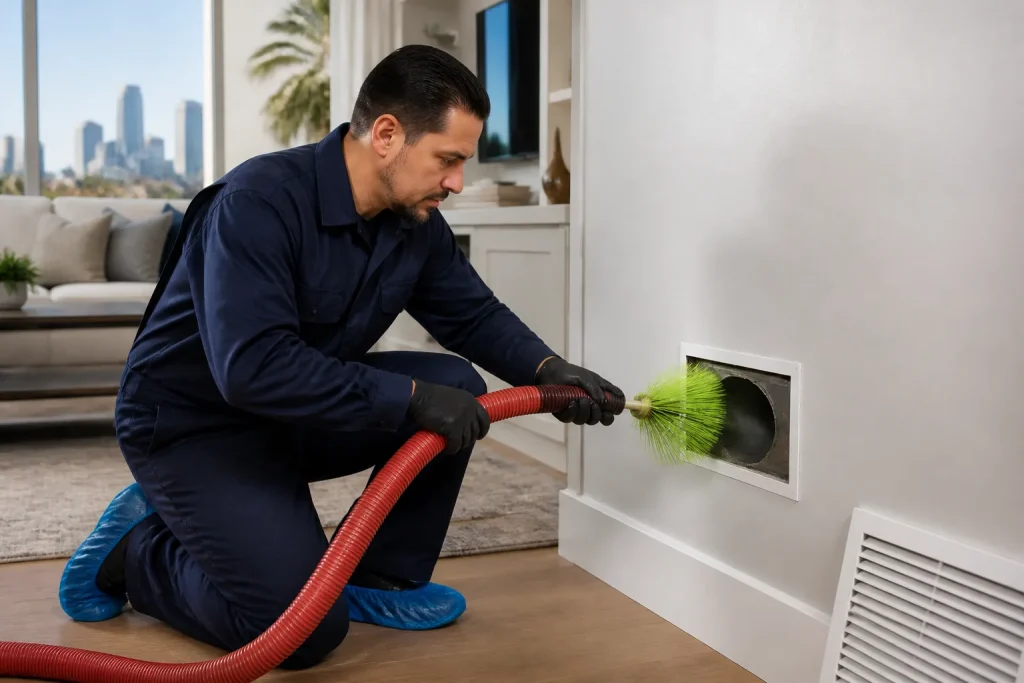
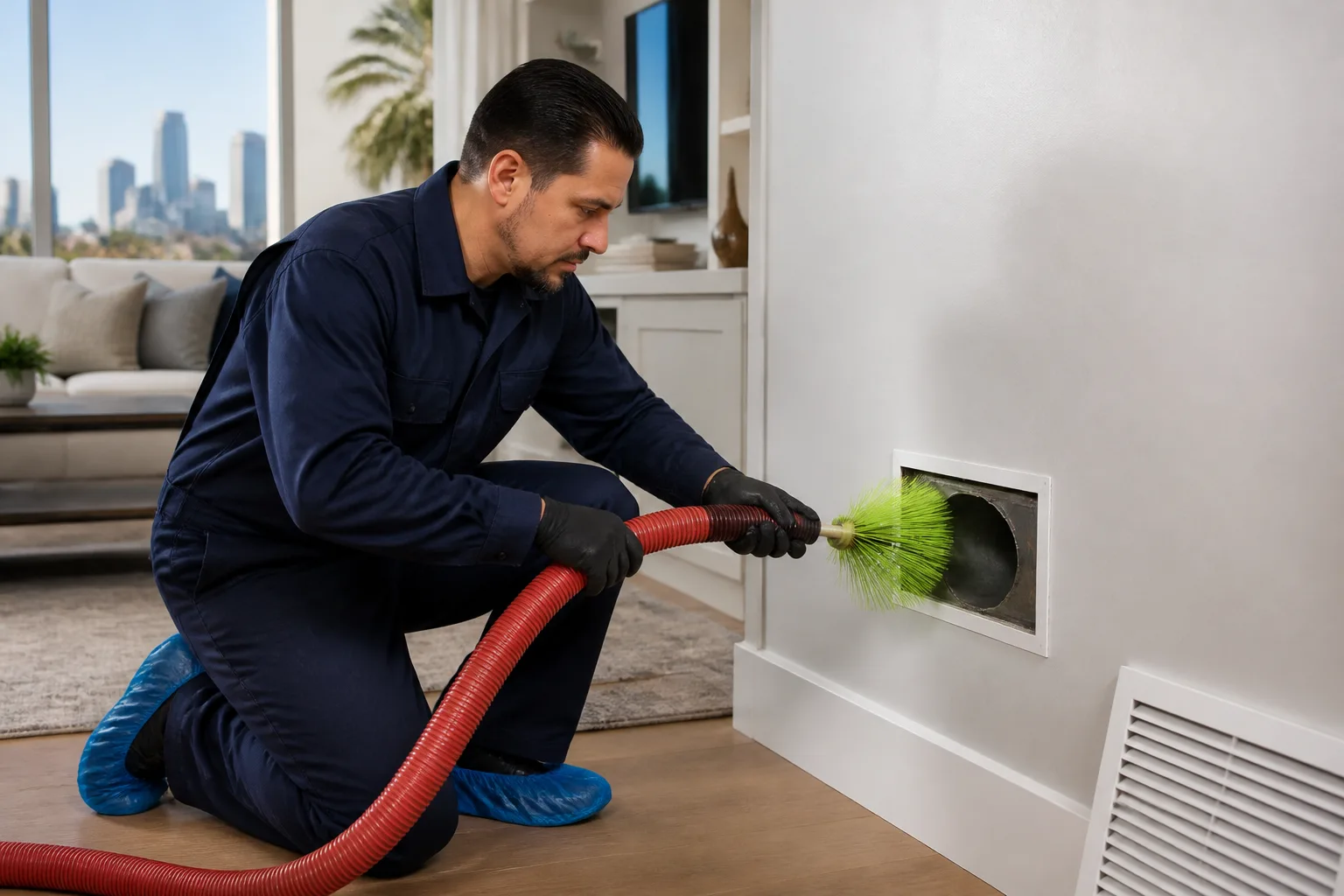
- Brush agitation through the branch lines. While negative pressure pulls from the trunk, the technician works a rotary brush through individual branch lines to dislodge debris. This is where Nikro and Rotobrush work together: agitation loosens, negative pressure extracts.
- Final camera verification. A camera pass through the trunk lines confirms the system is clean. You should see it, not just hear about it.
In our experience, the whole process for a typical 2,500-square-foot Los Angeles home takes three to five hours. If a contractor claims they can do Nikro-class work in 90 minutes, they’re skipping steps.
Nikro vs. Rotobrush: How the Two Systems Actually Work Together
Here’s the comparison that matters for Los Angeles homeowners researching equipment.
Rotobrush systems use a rotary brush attached to a flexible shaft. The brush spins inside the duct, physically scrubbing debris loose from the walls. It’s direct contact cleaning. It works well in branch lines and smaller residential systems where the brush can reach every surface. Rotobrush also has an integrated vacuum that captures the loosened debris as the brush works.
Nikro negative-air units create sustained airflow that pulls debris toward a collection point. They don’t scrub. They extract. In a large trunk line, a rotary brush can stir debris into the air, but the integrated vacuum often can’t move enough air to carry that debris the full length of the trunk. A Nikro unit can.
Think of it as the difference between sweeping a long hallway with a broom versus opening both doors on a windy day. The broom works great in a small room. The wind does the job in a hallway too long for the broom to reach.
In a properly executed cleaning on a large Los Angeles home, both are used. The Rotobrush handles branch lines and direct contact. The Nikro unit handles trunk line extraction, creating the negative pressure that moves everything toward the collection bag. It’s not either/or. It’s sequence.
What It Costs and Why the Range Is Wide
Most Los Angeles homes with large central systems run between $600 and $1,400 for a Nikro-class negative-air cleaning. Smaller homes that don’t need negative-air extraction typically run $350 to $600. The range depends on system size, number of access points required, and how much debris is actually in the system.
- Small homes under 1,800 sq ft: $350 to $600. Rotobrush-based cleaning is usually sufficient.
- Mid-size homes 1,800 to 3,000 sq ft: $500 to $900. A blend of rotary brush and negative-air extraction, depending on trunk line complexity.
- Large homes 3,000 sq ft and up: $800 to $1,400. Nikro-class negative-air extraction warranted for long trunk lines and high air volume.
- Post-construction cleanouts: $500 to $1,200 depending on debris type and system size. Construction dust requires extra filtration time.
One flat price per system, agreed before work starts, is the standard you should expect in Los Angeles. If a contractor wants to quote per vent, that’s a billing model designed to expand at the door. The written price should be in your hands before a single access point is cut. At Kestrel Air Duct Cleaning, that’s a standing commitment, not a promotional offer. You can read more on our Air Duct Cleaning in Los Angeles page.
The Bottom Line
Nikro negative-air equipment is genuinely different from residential-grade vacuums, and for large Los Angeles homes with long trunk lines, it’s the right tool. But the machine is only as good as the technician running it. Access-point placement, system isolation, and verification all matter as much as CFM. Ask to see pressure readings, the collection bag, and a camera pass when the work is done. If a contractor can’t show you those, the equipment they’re running isn’t doing what it should.
If you’re in Los Angeles and want a straight answer about whether your home warrants Nikro-class cleaning, Kestrel Air Duct Cleaning home offers free estimates. Call (469) 972-3151. You’ll get the written price before any work begins, and if the work falls short within the guarantee period, we return and make it right at no charge. That’s the Kingswell Guarantee, in writing, on every job.
Frequently Asked Questions
For homes with 3,000 square feet or more, long trunk lines, or post-construction debris, Nikro-class negative-air extraction removes debris that a portable vacuum cannot reach. The sustained pressure differential, typically 4,000 to 6,000 CFM, pulls debris through long duct runs rather than relying on mechanical contact alone. For smaller homes with short ducts, a proper Rotobrush cleaning is usually sufficient and the extra cost isn’t necessary. Call (469) 972-3151 for an honest assessment of what your home actually needs.
Request a camera pass through the trunk lines after the cleaning. You should see clean duct surfaces, not a remaining film of dust. Also ask to see the collection bag from the Nikro unit. What came out of your system tells you whether the work was real. Pressure gauge readings during the job confirm the negative-air system was actually pulling. If a contractor resists showing any of these, that’s an answer in itself.
Not automatically. A Nikro negative-air unit only performs when access points are placed correctly and the system is isolated so airflow is directed through every section. If registers aren’t sealed and airflow takes the path of least resistance, the machine can pull 5,000 CFM and still miss most of the debris. Technique and equipment matter equally. Ask about process, not just machine specs. For a cleaning backed by a written guarantee, our Dryer Vent Cleaning in Los Angeles service applies the same standard to vent systems.
Every five to seven years for most homes. Homes with pets, recent renovations, or residents with allergies may need it every three to four years. Los Angeles dust, which includes fine particulate from traffic and dry conditions, accumulates faster than in wetter climates. If you’ve never had it done and the home is older than ten years, it’s time. Call (469) 972-3151 and we’ll give you a straight answer, not a sales pitch. Our prices are flat per system, written before any work starts, so you’ll know exactly what it costs before you commit.
Written by Dale Whitmore, Owner at Kestrel Air Duct Cleaning, serving Los Angeles since 2004.
Need Air Duct Cleaning Help?
Call Kestrel Air Duct Cleaning - licensed & insured, here with fast after-hours help in Los Angeles.
(469) 972-3151