
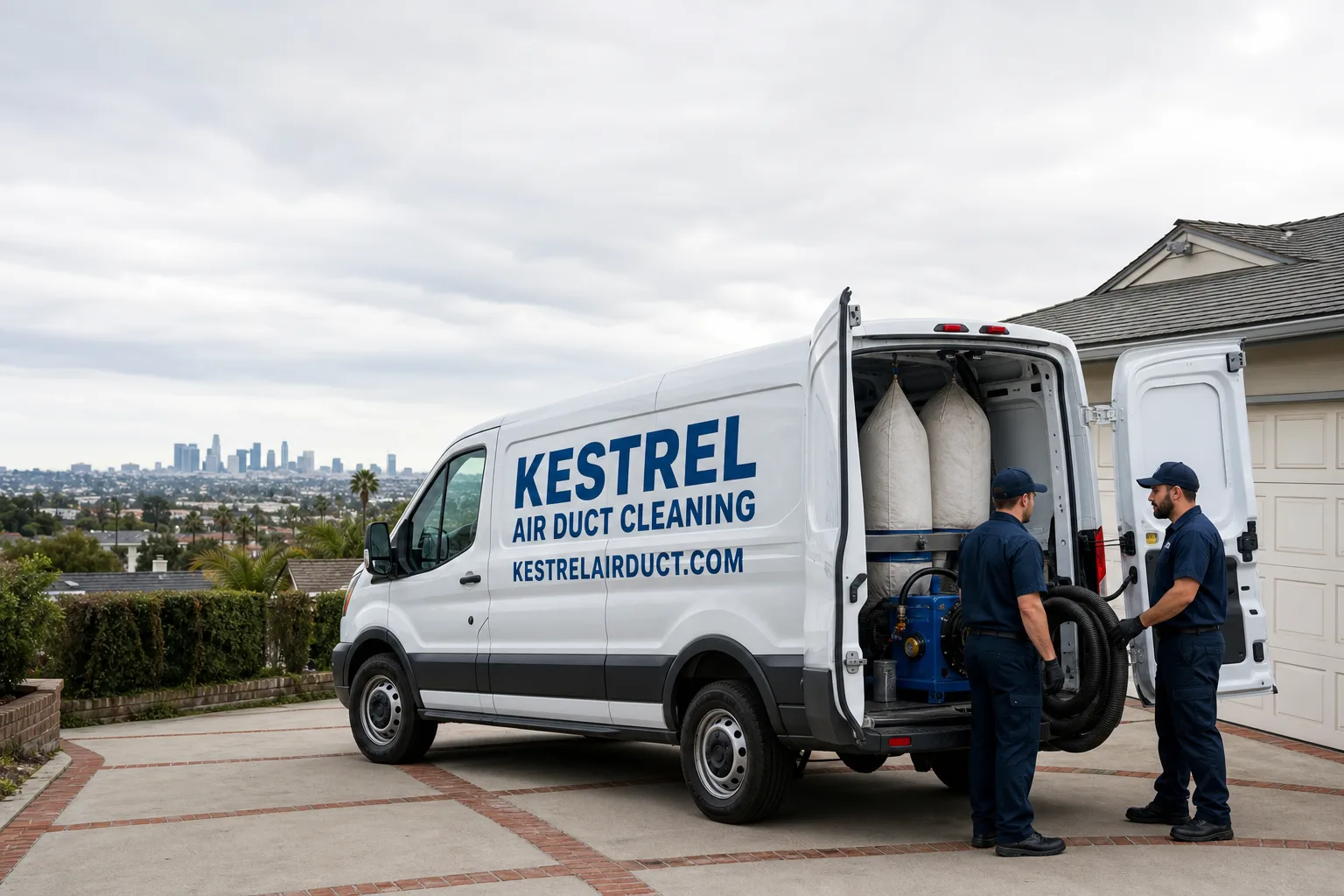
Whole-system duct and dryer vent check with before-and-after photos - you see exactly what came out of your vents
That "$99 whole-house special" is a bait ad - the real number appears once they are in your hallway, or the "clean" is a shop-vac at the register. We photograph the inside of your ducts before and after instead.




 Before
 After
After Before
 After
After Before
 After
AfterAllergies Worse Indoors
What’s Happening
If your allergy symptoms get worse the moment you step inside and ease up when you leave, your duct system is almost certainly the source. Every time your HVAC runs, it pulls air through those ducts and delivers whatever has built up inside – dust mite debris, mold spores, pet dander, pollen that drifted in and settled – straight into the rooms you live in. Air duct cleaning removes that accumulated load so your system stops redistributing it every time the fan kicks on.
Most people assume outdoor air is the problem. And in allergy season, it partly is. But the duct system in a typical home acts like a slow-accumulation filter that never gets emptied. Debris collects on duct walls year after year. When the blower runs, it stirs that debris back into circulation. A home where the ducts haven’t been cleaned in several years can have a noticeably higher particle load in the indoor air than a home with clean ductwork – and that difference is exactly what allergy sufferers feel. The symptoms are real. The cause is usually fixable.
Why It Happens
Dust, Dander, and Debris Built Up Over Years
This is the most common culprit by a wide margin. Every time air moves through your duct system, it carries fine particles with it. A portion of those particles settle on the interior surfaces of the ducts rather than making it all the way through. Over time, that layer thickens. When you have pets, run a wood shop in the garage, or live near a road with heavy traffic, the accumulation speeds up. A visible sign: pull one of your supply vent covers and look at the interior wall of the duct with a flashlight. A thin coat of grey dust is normal. A thick, fuzzy, dark-grey layer is the problem.
Mold or Mildew Inside the Ductwork
Ducts that pass through unconditioned spaces – attics, crawl spaces, basements – are exposed to temperature swings that can cause condensation on the interior metal surfaces. Moisture plus organic debris equals mold. You may not see it from the vent register, but you might notice a musty, slightly earthy smell that appears shortly after the system starts running and then fades. That smell is often the first sign that mold has established itself somewhere in the duct run. If you notice that smell and your symptoms are worst right after the system kicks on, mold contamination in the ducts deserves serious consideration.
A Dirty or Bypassed Air Filter
The air filter is the first line of defense against particles entering the duct system. A clogged filter stops doing its job – and in some cases the airflow restriction causes air to bypass the filter entirely through gaps in the filter housing. If the filter looks visibly grey and compacted when you pull it out, it has been working hard but is now overdue for replacement. Check whether the filter fits snugly in its slot with no visible gap around the edges. Even a small gap lets unfiltered air stream straight into the system.
Leaky Duct Connections
Ducts that pass through attics, garages, or crawl spaces can develop loose joints or small holes over time. When the system is under negative pressure during operation, those gaps pull in unconditioned, unfiltered air from whatever space surrounds the duct – often air that carries insulation fibers, dust, and other irritants. If your allergy symptoms are concentrated in certain rooms, or if you notice that some rooms feel dustier than others, a gap in the duct run serving that zone is worth looking at. Your local Kestrel Air Duct Cleaning team can identify leaks during an inspection.
What to Do Right Now
- Check your air filter first. Pull it out and hold it up to a light. If you can’t see light through it, replace it before the system runs again. Note the brand and MERV rating on the frame so you replace it with the right type – Honeywell and Aprilaire both make filters designed for residential systems, and the rating matters.
- Stop running the system if you suspect mold. If you smell that musty-after-startup odor, running the system keeps circulating whatever is in the ducts. Turn it to fan-only or off and call for an inspection. Don’t run a DIY cleaning tool into ducts that may have mold – you can disturb spores and push them further into the system.
- Photograph the inside of one or two duct runs with your phone. Pop a register cover off, hold your phone in with the flashlight on, and take a picture. This gives the technician a baseline view of what’s inside before arrival and helps you understand what you’re dealing with.
- Do not attempt to clean ducts yourself with a shop vacuum. A standard shop vac creates positive pressure at the nozzle and negative pressure in the room, which means it pushes as many particles back into the air as it removes. Professional negative-pressure equipment is designed specifically to prevent this. Leave the interior duct work to the pros.
- Note when symptoms are worst. Write down whether they’re worst in the morning before the system runs, right after the system kicks on, or in a specific room. That pattern tells a technician a lot about where the contamination is concentrated, and it will make the inspection go faster.
How We Fix It
When your local Kestrel Air Duct Cleaning team arrives, the first thing a technician does is walk the system – locating supply and return registers, checking the filter, and looking for any visible signs of what’s been building up. Before a single vent cover comes off for cleaning, you’ll have a written price in hand. That’s not a formality; it’s how every Kestrel job works, every time, with no revisions at the door. The technician connects a Nikro negative-pressure unit to the system, creating controlled suction that keeps loosened particles from escaping into your living space. A Rotobrush rotary brush system then scrubs the interior duct walls, dislodging debris that simple suction alone wouldn’t move. Abatement Technologies HEPA filtration captures what comes out. For most residential systems this process takes two to four hours. The work is covered by the 365-Day Done Right Promise: if something isn’t right within that period, we come back and make it right at no charge – in writing, on the paperwork you keep.
Frequently Asked Questions
Dirty ducts can absolutely cause or worsen allergy symptoms. When your HVAC system runs, air moves through every section of ductwork at speed, and anything settled on those interior surfaces – dust mite waste, mold spores, pet dander, pollen – gets picked up and delivered into your living space. If your symptoms are consistently worse at home than they are outdoors or in other buildings, the duct system is one of the first things worth investigating, not the last.
For most healthy adults, heavily contaminated ducts are an ongoing discomfort rather than an immediate medical emergency. But if anyone in the home has asthma, a compromised immune system, or is very young or very old, a high particle load in the indoor air deserves faster attention – those groups are meaningfully more vulnerable to airborne irritants. Mold inside ductwork is a different situation; the longer it runs undisturbed, the more established it becomes and the more spores it distributes. If you suspect mold, don’t put the call off. Reach out to your local Kestrel team or call us at (469) 972-3151 and we’ll help you figure out what you’re dealing with.
Air duct cleaning is a scheduled service – a technician needs time to set up negative-pressure equipment properly and work through the full system, so it’s not something we dispatch in an hour the way a plumber might for a burst pipe. Call us at (469) 972-3151 and a real person will answer, any time of day, to find the earliest available appointment for your area. Your local Kestrel Air Duct Cleaning team will give you a real arrival window – not a four-hour guess – and we show up in it.
Before-and-after photos of your specific duct runs are part of how the job is documented, so you can see the difference rather than take anyone’s word for it. The 365-Day Done Right Promise is also in writing on your paperwork: if the work falls short within that period, we return and make it right at no charge. That’s not a verbal assurance – it’s a documented commitment that stays with you after the technician leaves. If you have questions about what the process looks like, call (469) 972-3151 and we’ll walk you through it before you book anything.
Get It Fixed
Your local Kestrel Air Duct Cleaning team is ready to take a look. Call (469) 972-3151 – a real person answers every call, any time – or book online. You’ll get a written price before any work starts and a real arrival window we’ll actually keep.
Written by Dale Whitmore, Owner at Kestrel Air Duct Cleaning, serving communities across the country under the Kingswell Guarantee since 2004.
What Our Customers Say
"Our dryer was taking two cycles to dry a load. They cleaned the vent and pulled out a frightening amount of lint. Dries in one cycle now and honestly I feel better about the fire risk."
- Marcus Lee"Set up an appointment for the whole house plus the dryer line. They called the morning of to confirm, showed up in the window, and showed me pictures of the gunk they pulled out. Worth it."
- Terrence Boyd"My wife's allergies were awful every morning. Had the ducts done and it's made a real difference. Tech was on time and wore booties in the house without me asking."
- Rob Pendergast